


Business Intelligence · May 2026 · 10 min read
You have 8 minutes. A Japanese manager is standing in front of you at their booth — composed, polite, and non-committal. Their business card is already in your hand. Three other visitors are circling.
Without a clear speed meeting strategy, those 8 minutes will produce a bow, a brochure, and a phrase you will hear at every Japanese exhibition: “Please send the document later by email.”
A speed meeting strategy is the structured approach that transforms brief, pressured exhibition encounters into qualified pipeline entries. For Sales, Business Development, and Marketing professionals targeting the Japanese manufacturing market, it goes further — it accounts for the specific communication patterns, document expectations, and relationship dynamics that govern how Japanese buyers make decisions.
According to research published in the Harvard Business Review, high-context business cultures such as Japan place significantly greater weight on trust-building, preparation signals, and the quality of initial encounters than low-context counterparts — making structure not a convenience, but a competitive necessity.
This article gives you 10 field-tested steps to build and execute a speed meeting strategy that works at exhibitions in Japan and at global industry events where Japanese manufacturing buyers are present.
Why a Speed Meeting Strategy Matters — By Role
The pressure of brief exhibition encounters is felt differently depending on your function. Here is what a structured speed meeting strategy unlocks for each team engaging Japanese manufacturing prospects.
Marketing
Japan-Ready Messaging That Lands
Brief structured conversations reveal in real time whether your Japanese-language materials, infographics, and product positioning resonate — before you invest in a full campaign cycle.
C-Level
Strategic Access to Senior Japanese Decision-Makers
Japanese C-suite contacts are accessible at exhibitions in ways they rarely are through office channels. A prepared, respectful opening — delivered with the right materials — converts polite interest into a scheduled follow-up discussion.
Business Development
Pipeline That Moves at the Japanese Market’s Pace
BD teams targeting Japan must filter the right contacts quickly and then invest follow-up energy precisely — because attention windows close fast and over-communicating too early is as damaging as going silent.
For context on how exhibitors and buyers evaluate meeting outcomes at trade events, both UFI – The Global Association of the Exhibition Industry and the CEIR – Center for Exhibition Industry Research publish benchmarks on visitor engagement and meeting conversion at industry events. The Harvard Business Review’s Sales section provides frameworks on structured short-form conversations and their role in BD conversion across international markets.
Speed Meeting Strategy: Steps 1–6 — Before and During the Conversation
The Core Principle
A speed meeting strategy is not about talking faster. It is about entering every brief conversation with a defined objective, a structured opening, and a pre-planned exit that leaves both parties with a clear next step. In high-context cultures like Japan, how you enter a conversation signals as much as what you say — preparation is visible, and it is respected.
Step 1
Book Meetings in Advance — Whenever the Exhibition Allows It
If the event provides a designated speed meeting area or pre-booking system, prioritise it. A confirmed appointment with a Japanese prospect before the exhibition begins is worth ten unannounced booth visits.
Japanese business culture places high value on planned interactions — an advance request signals respect and intent, while a walk-up approach can feel presumptuous. Use LinkedIn, the event’s official app, or direct email to request 15 minutes at their booth before the show opens.
Step 2
Prepare Your Killer Phrase — One Sentence That Triggers Attention
When pre-booking is not possible, your opening line must do the work. Prepare one precise sentence that names a problem your prospect recognises and implies you have the answer. This is not a pitch — it is an attention trigger.
For Japanese buyers, specificity and relevance to their industry matter far more than enthusiasm. A phrase that directly references a challenge in their manufacturing sector will open a conversation that a generic introduction will not.
If the topic lands, make your ask immediately: “Would it be possible to arrange 20 minutes during the exhibition — or a call in the week after?”
Step 3
Arrive With Japanese-Language Materials — Not a Promise to Send Them Later
Japanese prospects will almost invariably say: “Please send the document later by email.” This is not a buying signal — it is a polite deferral. The way to convert it into genuine interest is to hand over a Japanese-language brochure, one-pager, or infographic at the moment of the conversation.
While English proficiency has increased significantly since the 1990s, most Japanese manufacturing managers are far more comfortable evaluating a proposition in their own language — particularly managers who do not operate internationally on a daily basis.
Research by Hofstede Insights on Japanese business culture confirms that written communication in the local language is a key trust signal in formal B2B contexts. Having Japan-suited materials ready is a market commitment signal, not just market interest.
Step 4
Listen More Than You Speak — And Do Not Go Deep Unnecessarily
BD professionals who over-explain in the first meeting lose the Japanese buyer’s attention quickly. A speed meeting strategy is a qualification exercise, not a product demonstration. Ask one well-framed question, listen carefully, and resist the impulse to fill silences with more detail.
Japanese business communication often involves deliberate pauses — these are thinking moments, not invitations to keep talking. According to Erin Meyer’s The Culture Map (2014), high-context communicators derive meaning from what is not said as much as what is — learning to read restraint is as important as crafting the right words.
Step 5
Categorise Interest Levels — and Score Each Contact Before Moving On
Not all polite conversations are equal. Before walking away from each booth, classify the contact using a simple three-tier system: Hot (expressed specific interest or agreed a next step), Warm (engaged but non-committal), or Cold (courteous but out of scope).
This categorisation drives the entire follow-up structure. Japanese prospects who showed genuine attention — even quietly — belong in the Hot tier and require action within 72 hours.
As Neil Rackham’s SPIN Selling research demonstrates, the value of a conversation is determined not by its warmth but by the signals exchanged — and those signals need to be captured while they are fresh.
Step 6
Control the Clock — Frame Brevity as Professionalism, Not Rush
Name the time constraint early and frame it with respect: “I have about ten minutes before my next meeting — I want to make sure we use the time well.”
In the Japanese business context, this kind of directness about time, when delivered calmly and respectfully, is read as consideration rather than impatience. It also gives the other party permission to be clear about their level of interest — which saves both sides from a conversation that goes nowhere politely for twenty minutes.
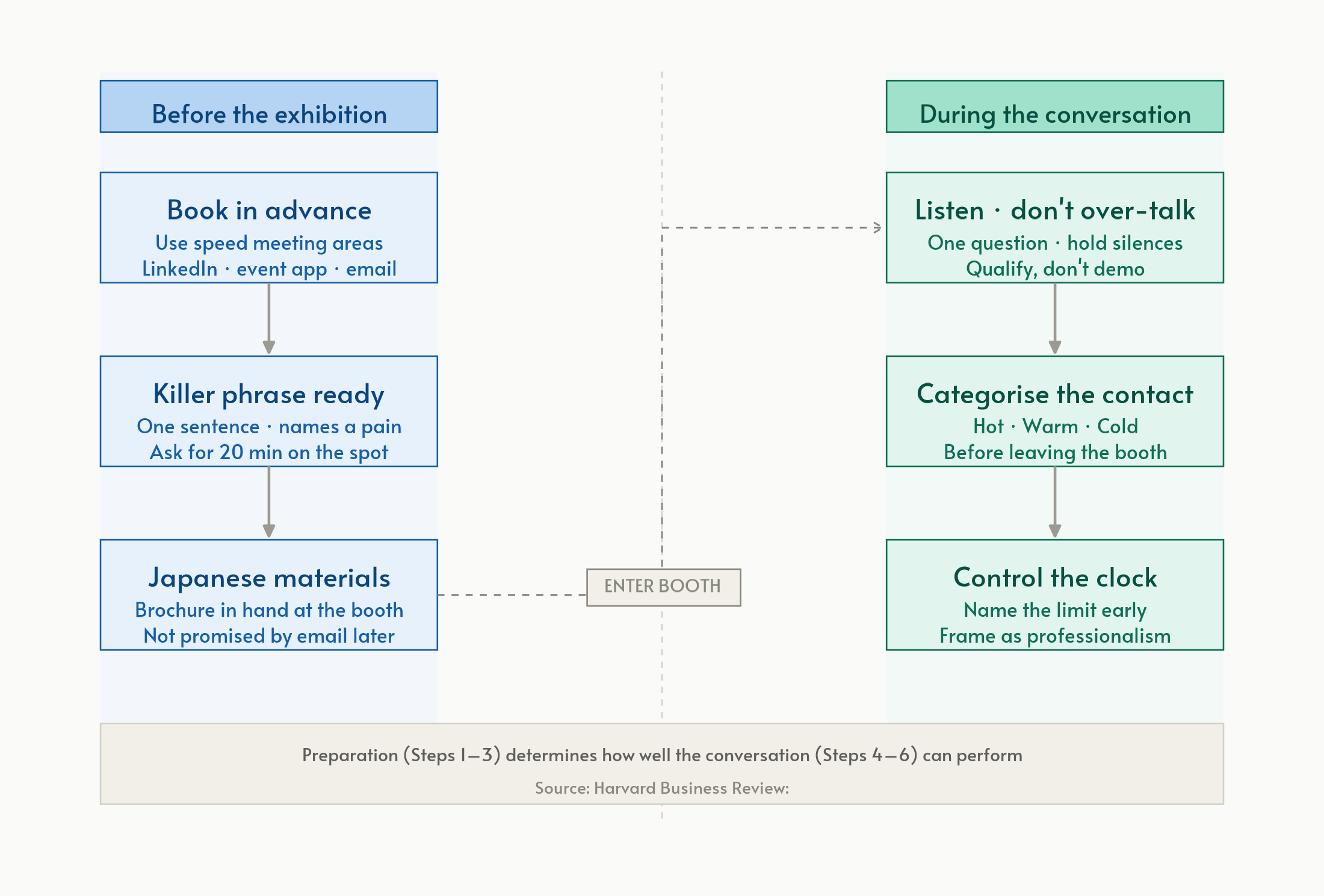
Steps 1–6 of the speed meeting strategy cover preparation and in-conversation behaviour — with specific adaptations for Japanese manufacturing buyers.
Where Speed Meeting Strategy Breaks Down With Japanese Buyers
Even experienced Sales and BD professionals make predictable mistakes in Japanese exhibition environments. A well-designed speed meeting strategy anticipates — and prevents — these failure patterns before they cost you the relationship.
The Most Costly Mistake
Leaving a conversation with only a business card and a plan to “follow up soon” is not a result — it is a slow decline. Japanese buyers return to their offices and re-enter demanding workloads immediately.
Their attention for a new foreign supplier is not saved for later; it dissipates within days. If no concrete follow-up action is agreed at the exhibition itself, the chance of re-opening that conversation drops significantly. Do not leave follow-up undefined, and do not leave it longer than 3 days.
English-Only Materials
Handing a Japanese manufacturing manager an English-only brochure signals that your Japan entry is aspirational, not operational. Most managers outside international divisions will not read it.
Materials prepared in business-appropriate Japanese — not machine-translated text — are the standard expectation, not a differentiator.
Over-Talking in the First Meeting
A BD professional who fills every pause with more product detail is signalling discomfort with silence rather than confidence in the offer. Japanese buyers use silence constructively.
Over-talking reads as either desperation or a lack of preparation — neither is recoverable in a first encounter. Say less. Mean more. Leave space.
Waiting More Than 3 Days to Follow Up
Japanese professionals re-enter their daily workloads quickly after events. A follow-up that arrives four or more days after the exhibition reaches someone who no longer clearly remembers the conversation.
The attention window is short — and the competition for their inbox does not pause. Act within 72 hours, without exception for Hot and Warm contacts.
Treating All Contacts the Same After the Event
Sending the same follow-up email to a Hot prospect and a Cold contact is not follow-up — it is noise. Japanese buyers are particularly sensitive to generic communication.
Categorise before you follow up, and write each message to reflect what was actually discussed — an effective speed meeting strategy makes this possible because the notes were taken in real time.
Speed Meeting Strategy: Steps 7–10 — Closing and Converting Japanese Prospects
The Close — While Still at the Booth
Agree the Next Step in Person — a Specific Date, Not a Vague Promise
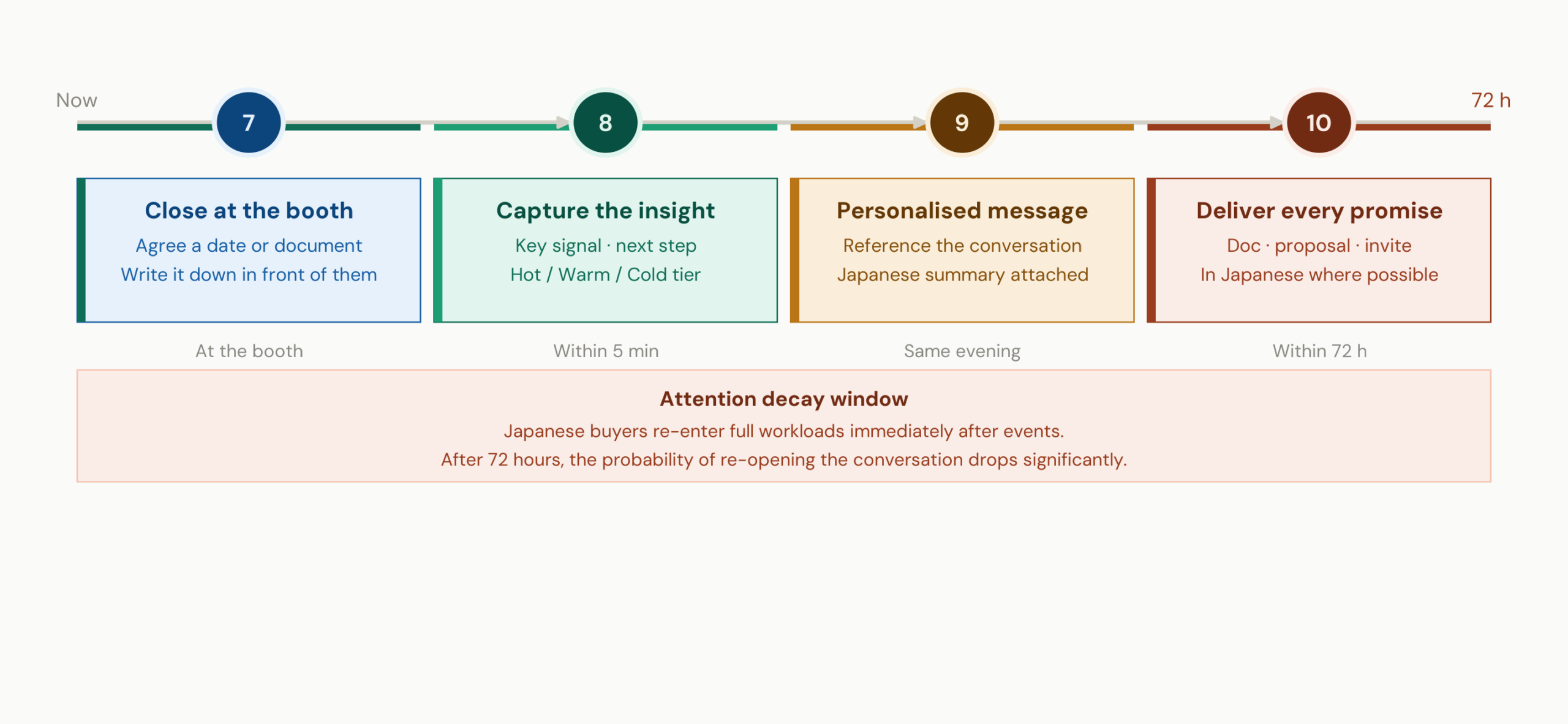
Before the conversation ends, agree on one concrete action: a scheduled call date, a document to send, or a referral to a relevant colleague. Frame it as a natural continuation: “Based on what you’ve shared, I think a 20-minute call the week after the exhibition would be valuable — would Tuesday or Wednesday suit you?”
A verbal agreement made in person converts at a significantly higher rate than a follow-up email sent cold two days later. If the prospect expresses interest in your Japanese materials, confirm exactly what you will send and by when — and write it down in front of them.
Within 5 Minutes — Capture the Insight, Not Just the Contact
Record the Key Signal While It Is Precise — Before the Next Conversation
Contact details are on the business card. What is not on the card is the specific problem they mentioned, the timeline they implied, or the level of English comfort they demonstrated — all of which determine how you follow up.
Open your phone and type three things immediately: the key insight from the conversation, the agreed next step, and the contact’s interest category (Hot / Warm / Cold). Do this before the next booth visit — a speed meeting strategy only converts if the notes from each meeting are precise, not reconstructed hours later.
Same Evening — Send a Personalised Follow-Up That References the Conversation
A Message That Reflects What Was Said — Not a Template
Send a short, specific follow-up the same evening — by email or LinkedIn — that references something from the actual conversation. For Japanese prospects, this message should ideally include a Japanese-language summary or attach a Japanese-language version of the document discussed.
A generic message in English alone, sent to a Japanese manufacturing manager who does not regularly read English business texts, is likely to sit unread. Keep the message to three sentences: context of your meeting, the key point of relevance to their business, and the next step you agreed. Do not make it a pitch — make it a continuation of what was already started.
Within 72 Hours — Deliver on Every Commitment, Without Exception
The Follow-Up Window Is 3 Days — After That, Attention Closes
Japanese buyers return to demanding operational schedules immediately after exhibitions. The attention allocated to a new foreign supplier is narrow — and it does not stay open while you finalise your follow-up plan.
Any document, proposal, introduction, or calendar invite promised at the exhibition must arrive within 72 hours. Deliver it in Japanese where possible, with a professionally formatted presentation or infographic rather than a raw English PDF.
As the Harvard Business Review notes in its research on cross-cultural negotiations, reliability and consistency in early interactions are disproportionately predictive of long-term partnership outcomes in Japan. This final step is where a well-executed speed meeting strategy either converts — or quietly disappears.
From Strategy to Execution: How SATOM Supports Your Japan Market Entry at Exhibitions
A speed meeting strategy gives you the structure. Execution in the Japanese manufacturing market requires something more: materials in business-appropriate Japanese, presentations built for Japanese buyers, and a lead management process that respects the attention window.
Most international teams leave exhibitions with a pile of business cards from Japanese prospects and an English brochure they promised to translate — weeks later, the pipeline has gone cold. SATOM works with manufacturing companies entering or expanding in the Japanese market, with support built specifically for the exhibition environment — before, during, and after the event.
①
Japan-Suited Translation & Documents
SATOM prepares business-appropriate Japanese translations of your brochures, one-pagers, and technical documents — written for Japanese manufacturing audiences, not translated from English by machine.
Japanese-suited presentations and infographics are also produced so that your materials are ready to hand over at the booth, not promised for later.
②
Exhibition Field Coaching & Japan Support
For exhibitions in Japan, SATOM provides on-site support — including culturally informed guidance on how to approach Japanese prospects, how to read interest signals, and how to structure conversations that lead to scheduled follow-ups.
The field coaching is tailored to your team’s BD objectives and the specific event you are attending.
③
Japanese Prospect Lead Management
SATOM manages the post-exhibition lead pipeline for Japanese prospects — categorising contacts by interest level, preparing personalised Japanese-language follow-up communications, and ensuring every Hot and Warm contact receives a structured, on-time response within the critical 72-hour window.
No prospect goes cold because of a process gap on your side.
This is human-led advisory built on real exhibition and Japan market experience. It is not a translation tool or a generic sales script — it is contextual support that operates in the space between speed meeting strategy and execution, where most Japan market entries lose momentum.
Key Takeaways
- Book in advance wherever the exhibition allows — a confirmed appointment with a Japanese prospect is worth ten unannounced walk-ups.
- Prepare a killer phrase — one precise sentence that triggers attention and earns an onsite or post-exhibition discussion slot.
- Arrive with Japanese-language materials — not a promise to send them later. A Japan-suited document handed over during the speed meeting is a market entry signal, not a courtesy.
- Do not over-talk — BD conversations with Japanese buyers should be focused, restrained, and curiosity-led. Silence is part of the communication.
- Categorise every contact (Hot / Warm / Cold) before you leave the booth, and let that classification drive your follow-up approach.
- Follow up within 72 hours — Japanese buyers return to full workloads immediately after events. Attention that is not captured fast is not captured at all.
Japanese manufacturing exhibitions — whether in Tokyo, Osaka, or at international trade events — are concentrated windows of access that most foreign companies use poorly. The room is full of decision-makers. The opportunity is real. But it does not stay open.
A well-executed speed meeting strategy, backed by the right Japanese-language materials and a disciplined 72-hour follow-up process, is what separates a productive exhibition from an expensive business trip. Eight minutes, used deliberately and followed up precisely, is more than enough to open a Japanese market door that months of cold outreach could not.
Related Articles
Exhibition Preparation Checklist: 10 Steps Before You Go →
Exhibition Sales Strategy: A Field Guide for Sales and BD →
Further Reading and Sources
- UFI – Global Association of the Exhibition Industry — visitor engagement benchmarks, exhibitor ROI data, and Japan market event reports
- CEIR – Center for Exhibition Industry Research — data on meeting conversion rates and buyer behaviour at trade events
- Harvard Business Review – Sales — frameworks on structured prospect engagement, cross-cultural negotiation, and BD conversion in high-context markets
- Hofstede Insights – Japan Country Profile — cultural dimension analysis informing communication and decision-making patterns in Japanese business contexts