


Business Intelligence · May 2026 · 7 min read
Table of Contents
Every year, companies invest significant budgets in trade shows and exhibitions — booth design, travel, accommodation, and staff time. Yet one of the most common mistakes is surprisingly simple: arriving underprepared. An exhibition preparation checklist is not just a nice-to-have tool. It is the difference between a team that collects business cards passively and a team that returns with qualified leads, signed agreements, and strategic connections.
This article is for sales managers, event project leads, and C-level attendees who want to make every hour on the exhibition floor count. Use this exhibition preparation checklist to complete 10 essential steps before departure — regardless of industry, event size, or team role.
Why an Exhibition Preparation Checklist Changes Your Results
The problem is not motivation — it is time. Sales professionals are deep in their daily pipelines. Procurement managers are managing supplier relationships. C-level executives are running between board meetings. When the exhibition date approaches, preparation often becomes an afterthought.
Think of it like hiking without marking your waypoints. The scenery looks great, but you may never reach your target. An exhibition preparation checklist gives every role a structured, actionable path forward — even with limited time before the event.
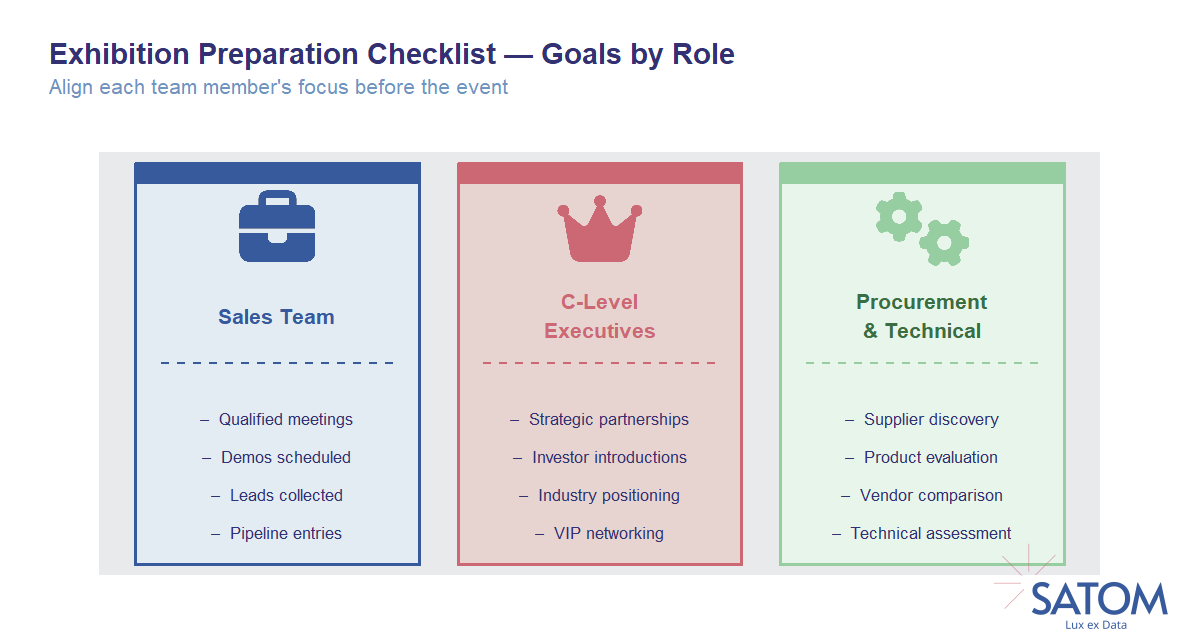
Sales Teams
Qualified meetings, demos scheduled, leads collected, pipeline entries
C-Level Executives
Strategic partnerships, investor introductions, industry positioning
Procurement & Technical
Supplier discovery, product evaluation, vendor comparison

For context on how leading organisations approach event preparation, both UFI – The Global Association of the Exhibition Industry and the CEIR – Center for Exhibition Industry Research publish useful benchmarks on exhibitor and buyer performance at trade events.
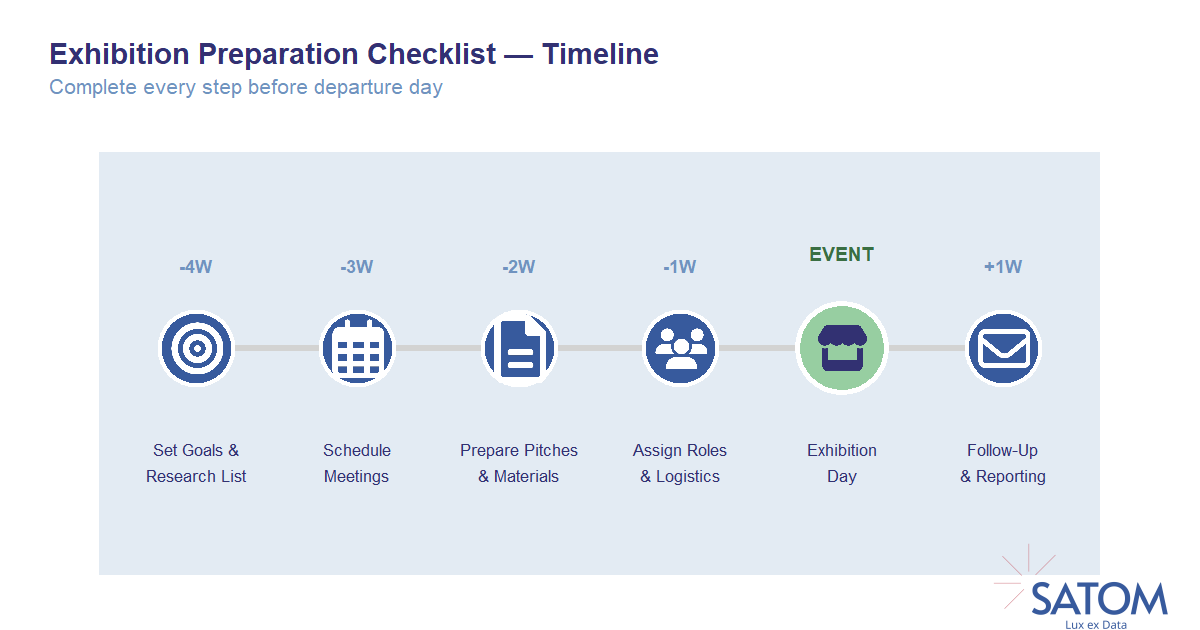
Steps 1 and 2: Define Your Goal and Research the Exhibitor List
The first two steps of any exhibition preparation checklist start with one question: why are you attending? Without a written goal, attendance becomes tourism.
Practical Tip
Many exhibitions offer pre-event meeting platforms or hosted buyer programmes. Register early — good time slots fill fast. Use the official event app to browse exhibitor profiles, filter by category, and lock in appointments before you travel.
Steps 3 to 6: Pitches, Materials, Roles, and Lead Capture
The middle section of your exhibition preparation checklist covers the operational details that determine how well your team performs on the floor.
Step 3
Prepare Your Pitch by Audience Type
A procurement manager and a CEO require entirely different conversations. Prepare three to five tailored talking points per audience type. Avoid a generic overview that fits everyone and convinces no one.
Step 4
Equip Your Team With the Right Materials
Business cards, one-page summaries, QR codes to landing pages, and a digital catalogue on a tablet. Everything ready at least one week before departure — no scrambling at the hotel the night before.
Step 5
Assign Roles and Responsibilities at the Booth
Who greets visitors? Who handles technical questions? Who collects contacts? Who follows up? Without defined roles, everyone does a little of everything and nothing gets done well.
Step 6
Set Up a Lead Capture System
A stack of business cards is not a system. Use a CRM-compatible method — a shared spreadsheet, a card scanner app, or your existing CRM. Every conversation becomes a traceable record before the day ends.
Common Patterns That Hurt Team Performance at Exhibitions
Watch Out For These Patterns
Even experienced professionals fall into these traps at large trade shows. An exhibition preparation checklist helps you recognise and avoid each one.
No Clear Goal Per Role
Sales staff arrive and stand at the booth waiting for visitors. Reactive instead of proactive. A trip that feels more like travel than opportunity.
Booth Drift
Without a priority list, two hours can disappear inside one pavilion’s entertainment zone. You leave with a tote bag and no useful leads.
Generic Pitches
The same presentation for every visitor signals you are not listening. Strong exhibitors tailor their opening based on who they are speaking to.
No Post-Event Plan
The most overlooked step is the one that happens after the show. If your follow-up process is undefined before you travel, leads go cold while your team recovers from the trip.
Steps 7 to 10: Executives, Logistics, and Post-Event Follow-Up
C-Level
Brief C-Level Attendees Separately
Executive attendees often follow a different programme: VIP lounges, roundtables, keynote sessions, and private networking dinners. Brief them separately with a personalised agenda — confirmed meetings, priority contacts, and key messages to reinforce.
All Roles
Plan the Logistics Without Assumptions
Travel, accommodation, badge collection, booth setup times, storage for materials, and local transportation — logistics failures on day one destroy momentum for the entire event. Assign one person as the operational coordinator and let them own this step completely.
Sales · Exec
Schedule Follow-Up Meetings Before the Event Ends
The best time to book a follow-up call is while you are still standing in front of the contact. Define your follow-up process before you travel: who sends the email, within how many days, and how leads are categorised as hot, warm, or information only.
All Roles
Prepare Your Post-Event Report Template in Advance
Notes on twenty-plus contacts need time and structure to become a useful internal document. Prepare your reporting format before you travel so your field notes become shareable output without extra work after you return.
How SATOM Supports Teams Before, During, and After the Exhibition
An article gives you the framework. Execution requires tools that are structured, role-specific, and ready to use without building from scratch. Most teams return from exhibitions with raw notes that take hours to process. In contrast, teams who complete SATOM’s exhibition preparation checklist framework arrive with a ready-made recording format and leave with a report that is ready to share.
①
Pre-Exhibition Setup
SATOM builds a custom checklist and evaluation sheet based on your goals — weighted criteria, segmented by sales, executive, and procurement roles. Designed for fast capture during live meetings.
②
During the Exhibition
The sheet turns impressions into structured records. Each contact is captured consistently against the same criteria — making post-event comparison straightforward and objective.
③
Post-Exhibition Reporting
SATOM converts your completed sheets into a clean, professional exhibition summary — structured and ready to send to your team or stakeholders without additional editing time.
Additionally, teams who attend several exhibitions per year build a growing contact and supplier database over time. Each event adds more data. As a result, the value of the system increases with every visit.
Key Takeaways for Your Next Exhibition
- First, define a clear goal per role — sales, executive, and procurement each need a different target.
- Next, research the exhibitor list and pre-book appointments before you travel.
- Then, prepare tailored pitches and equip your team with the right materials at least one week before departure.
- Also, assign booth roles in advance and have a live lead capture system ready from day one.
- Finally, plan your reporting format and follow-up process before the event — not after you return.
In short, a well-structured exhibition preparation checklist rewards teams who use it. Trade shows are designed to engage, impress, and occasionally distract. However, teams who arrive with clear goals and the right tools leave with results that are measurable, shareable, and repeatable at the next event.
Further Reading and Resources
- UFI – Global Association of the Exhibition Industry — industry standards, research, and event benchmarks
- CEIR – Center for Exhibition Industry Research — data on exhibitor and buyer performance at trade events
- Eventbrite Business Event Resources — practical guides for event planning and attendance
Let’s Talk Japan Market Entry
Your next exhibition in Japan starts with the right content.
Reach out directly or connect on LinkedIn to discuss your Japan market entry support needs.