


Business Intelligence · May 2026 · 8 min read
You arrived at the exhibition. Badge on. Coffee in hand. A floor plan the size of a small country. And then — nothing. Brochures get collected. A few photos land in the group chat. A branded pen disappears into a pocket. And four hours later, you leave wondering what just happened.
Sound familiar? This is the quiet crisis of the modern Sales and BD professional at exhibitions. Without a clear exhibition sales strategy, even the most energetic trade show visit collapses into an expensive walk in the park. In fact, the challenge is not motivation — it is the absence of structure from the moment you step onto the floor.
As a result, this article is your practical field guide. Whether your manager sent you with vague instructions like “do some competitor research” and “network a bit,” or you are trying to move a project milestone forward, here is how to turn exhibition time into real business intelligence and real pipeline movement.
Why Most Sales and BD Professionals Waste Exhibition Days
Exhibitions are branded as networking events by their organisers. That framing sounds promising — until you realise it means very different things to different people.
For the exhibiting company’s sales team at a booth, it means pitching visitors. For you, however, as a visiting Sales or BD professional, it means something far more strategic. You are not there to be sold to — rather, you are there to identify the right people, open the right doors, and gather the right intelligence.
Think of your day at an exhibition like a hiking expedition. You would not walk into the mountains without a map, a destination, and an idea of what terrain to expect. Consequently, without a structured exhibition sales strategy, most Sales and BD staff default to the path of least resistance: browsing, photographing, and collecting. Interactive? Barely. Productive? Almost never.

The Three Pillars of a Strong Exhibition Sales Strategy
Every productive exhibition visit is built on three core activities. Together, they form the backbone of any effective exhibition sales strategy for Sales and BD professionals.
Pillar 1
Prospect Engagement
Identify the right contacts, open the right doors, and move your pipeline forward in person.
Pillar 2
Competitor Intelligence
Observe what competitors are showcasing, how they present, and where their market focus is heading.
Pillar 3
Market Research via KYC
Evaluate potential customers and partners against structured criteria to build live market intelligence.
Pillar 1: Prospect Engagement — Talk to the Right Person
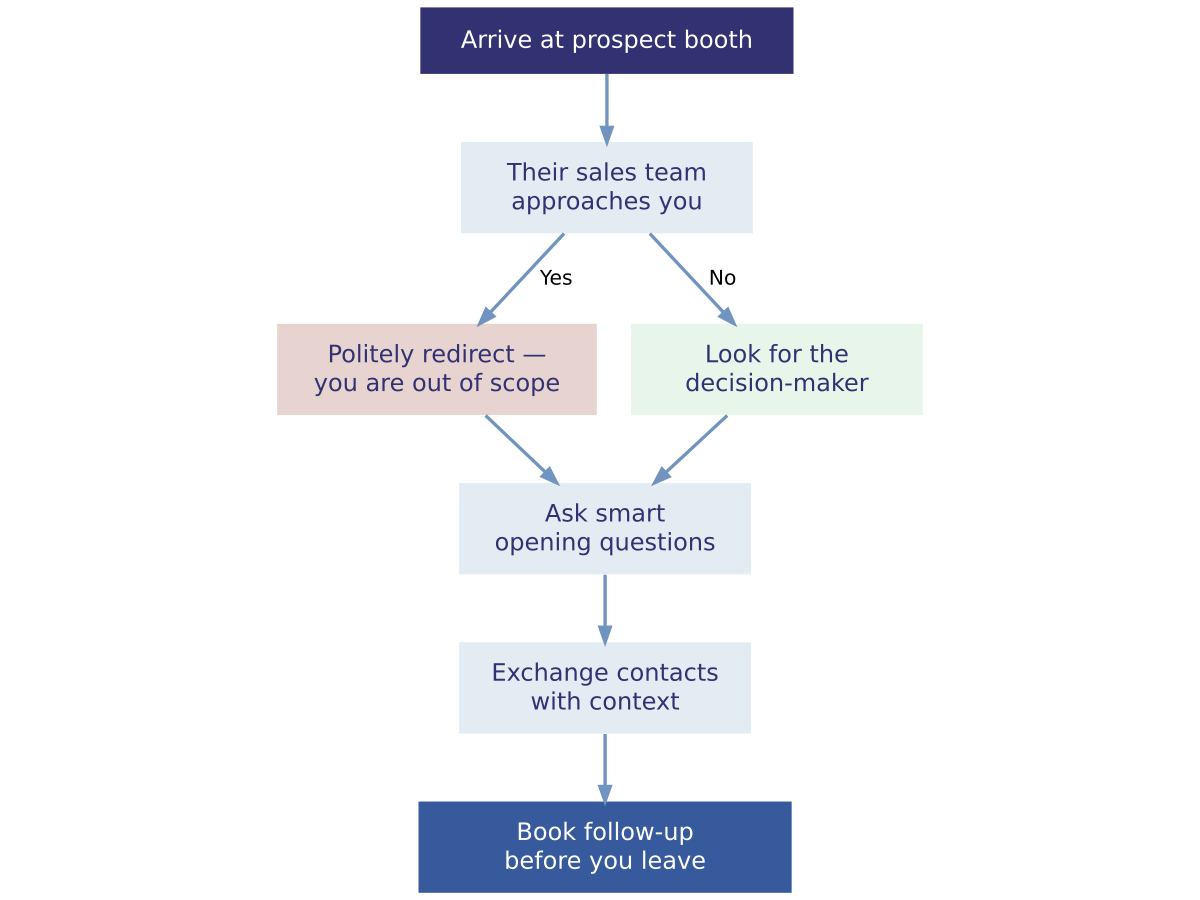
When you visit a prospect’s booth, their own sales team will often approach you first. That is natural — they are trained to do exactly that. However, here is the key insight: you are out of scope for their sales team. You do not need to be sold to. Politely redirect.
Instead, the person you are looking for is the one who would actually benefit from your company’s offer — procurement managers, technical leads, operations directors, or in some cases, the CEO themselves. Notably, at exhibitions these people are often more accessible than they ever are at their offices.
Practical Tip
Pre-schedule where you can. If you know which companies are exhibiting, reach out ahead of time via LinkedIn or email. Request fifteen minutes at their booth. A confirmed appointment is ten times more valuable than a walk-up conversation.
A few practical moves for effective prospect engagement as part of your exhibition sales strategy:
Four Moves That Make the Difference
Before the Visit
Pre-Schedule Your Key Meetings
Use LinkedIn or the official event app to reach out before the show. A confirmed fifteen-minute meeting turns a cold walk-up into a warm, structured conversation.
At the Booth
Ask Smart Opening Questions
Instead of launching into your pitch, ask what they are showcasing, what problems they are solving this year, or what their focus is at the show. Listen before you speak.
After the Conversation
Exchange Contacts With Context
Do not just swap business cards. Send a quick message immediately after so the connection has meaning when you follow up. A note that references your conversation is far stronger than a generic LinkedIn request.
End of Day
Book the Follow-Up Before You Leave
The best time to schedule a follow-up call is while you are still standing in front of the contact. Offer a specific date and time. Vague follow-up promises rarely convert.
Pillar 2: Competitor Intelligence — Observe With Respect
Competitor research at an exhibition is not espionage. Nevertheless, it does require intention and a degree of professionalism that many Sales and BD staff overlook. A strong exhibition sales strategy treats competitor observation as a structured discipline — not a covert operation.
What to Avoid
Avoid taking brochures without acknowledgement or photographing materials covertly. Similarly, resist asking pointed technical questions to junior booth staff hoping to extract sensitive information. The market is smaller than you think, and reputations travel quickly between events.
When visiting a competitor’s booth, apply these principles:
Observe What They Are Highlighting
What products or services take centre stage? What messaging dominates their display? What problems are they positioning themselves to solve? This tells you where they believe the market is moving.
Read the Booth Design Itself
A large, well-invested booth signals confidence and growth. A minimal or last-minute setup tells a different story. Booth investment is a proxy for strategic priority — and that is valuable intelligence.
Engage, If Appropriate
You do not need to conceal who you work for. A light conversation about the show itself — “Interesting crowd this year, isn’t it?” — can reveal a surprising amount about competitor positioning and priorities.
Maintain a Respectful Mindset
If a competitor’s staff is not engaging with you, do not push. Note what you observed and move on. Professionalism costs nothing and protects your company’s reputation in a shared industry space.
Pillar 3: On-Site Market Research Using the KYC Method
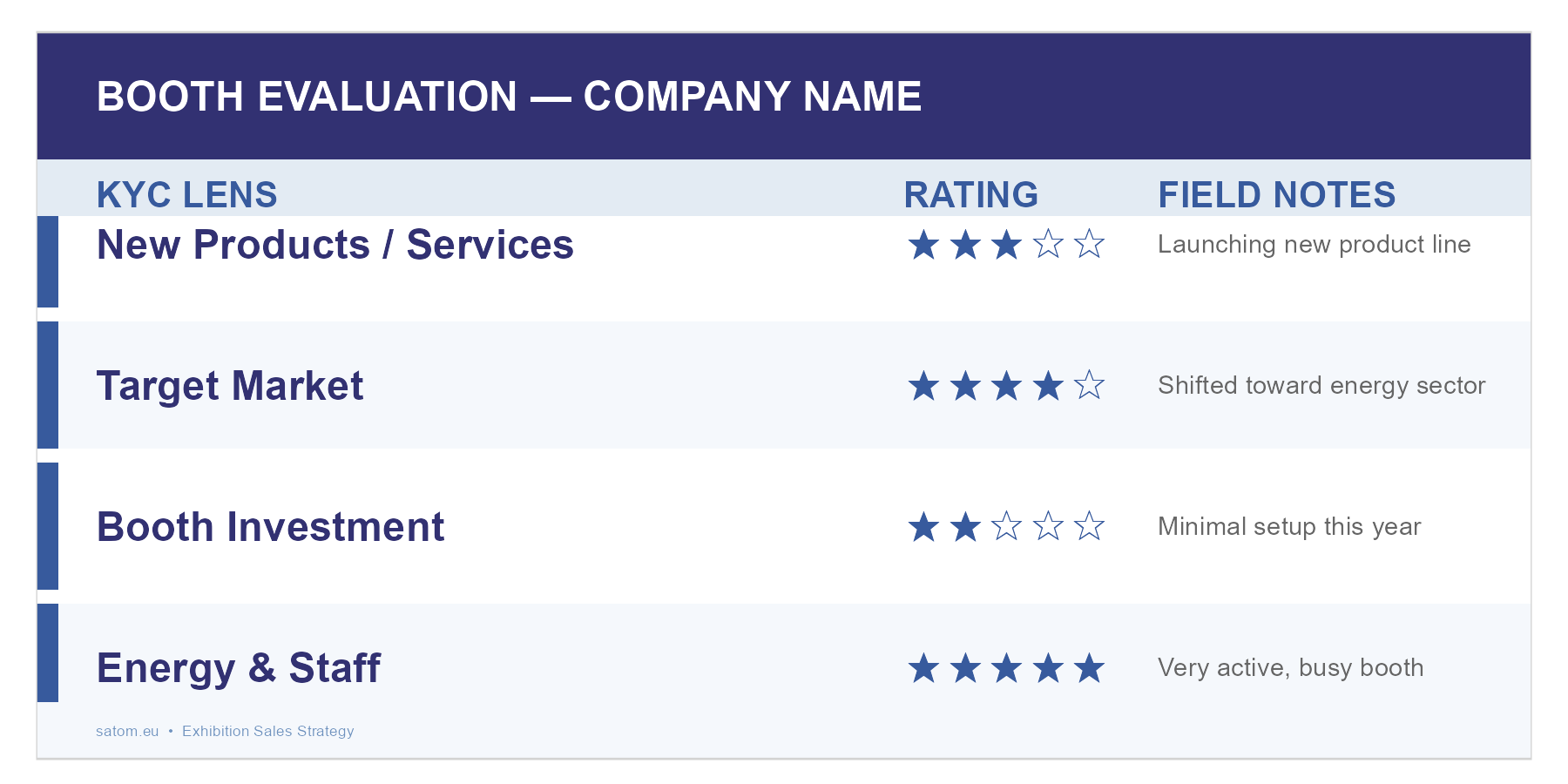
KYC — Know Your Customer — is a framework typically used in financial and compliance contexts. When applied as an on-site market research approach, however, it becomes one of the most powerful tools in your exhibition sales strategy. As you walk the floor and visit potential customer and partner booths, evaluate each one through four structured lenses.
| KYC Lens | What to Look For | Why It Matters |
|---|---|---|
| New Products / Services | Are they launching something? Pivoting their offer? | Signals strategic direction and potential new needs or opportunities. |
| Target Market | Which industries or customers are they pursuing? Has this shifted? | Helps you qualify whether they remain a viable prospect or have moved out of scope. |
| Booth Investment | How much resource have they put into their presence? | A proxy for business health, strategic priority, and growth momentum. |
| Energy and Engagement | Are their staff enthusiastic? Is the booth busy or quiet? | Reveals organisational morale and how seriously they are treating the event. |
Applied consistently across twenty or thirty booths in a day, this structured observation builds a surprisingly rich map of the market. Moreover, when you return to the office, you have data — not just impressions. Therefore, document your observations in real time — a simple note-taking template on your phone works perfectly. Do not trust memory at the end of an eight-hour floor walk.
What a Structured Exhibition Day Actually Looks Like
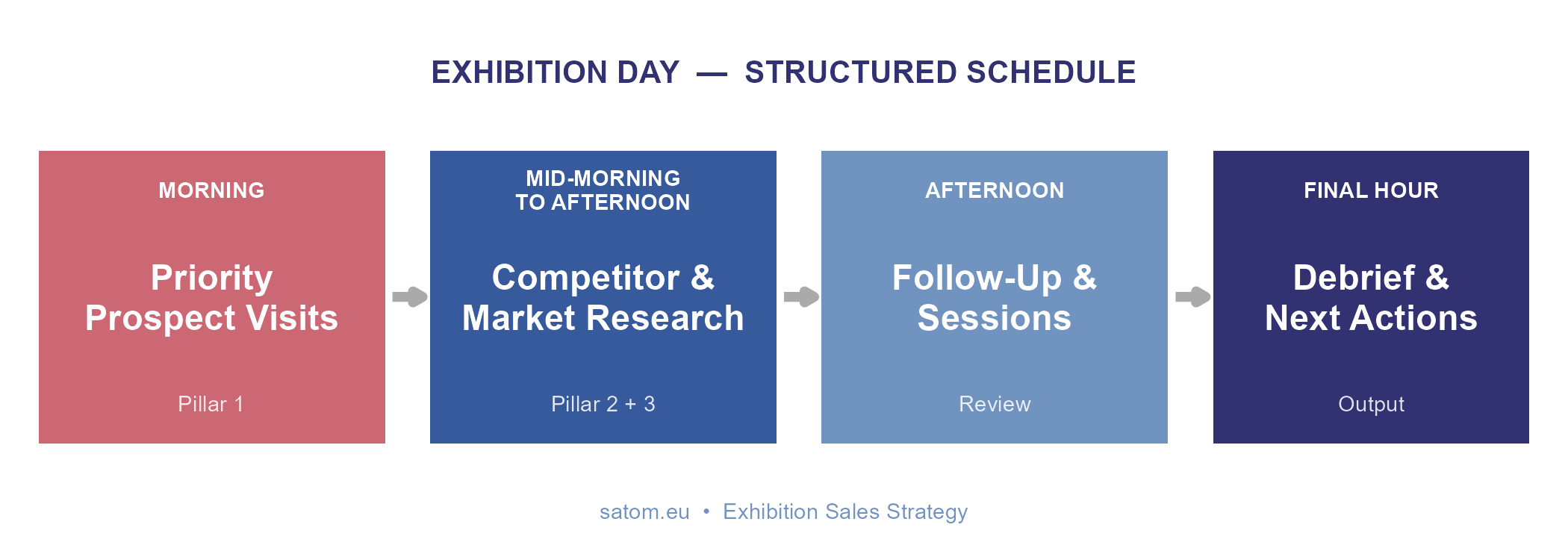
Here is how to structure your time on the floor so that all three pillars of your exhibition sales strategy get the attention they deserve.
Morning · First Two Hours
Priority Prospect Visits
Start with your top-priority prospect booths, as these are the meetings with the most strategic value. At this hour, people are fresher, booths are less crowded, and decision-makers are more likely to be present and available. In other words, mornings are your best window for high-quality conversations.
Mid-Morning to Early Afternoon
Competitor and Market Research Circuit
Work through your competitor observation and KYC market research loop, applying the structured lenses as you go. Take notes on each booth and collect materials — with permission and with context. This window is where your business intelligence is built.
Afternoon
Follow Up, Revisit, and Attend Sessions
Use the afternoon to follow up on contacts made in the morning. Where you missed the right person earlier, go back — decision-makers move around the floor throughout the day. In addition, attend any keynote or panel session that is directly relevant to your market or a target prospect’s industry.
Final Hour
Debrief Before You Leave the Building
Before leaving, review your notes and identify the three most important follow-up actions. Send connection requests or short messages to the most valuable contacts while the interaction is still fresh — not at the hotel at midnight.
The Mindset Shift That Changes Everything
The single biggest difference between a Sales or BD professional who gets results from exhibitions and one who does not is intentionality. An exhibition is not a day off from selling. Furthermore, it is not a company-funded browsing session.
Rather, it is a live, compressed environment where your competitors, your prospects, and your future customers are all in the same building at the same time. That is rare. As a result, a well-executed exhibition sales strategy treats every hour on the floor as exactly that — rare, and worth using deliberately.
Key Takeaways
- First, identify the right contact at each booth — procurement staff, technical managers, or decision-makers, not the sales team.
- Next, treat competitor visits as structured observation — respectful, intentional, and professionally executed.
- Then, apply the KYC method across your prospect list to build real-time market intelligence at scale.
- Also, structure your day into morning priority meetings, midday research, and afternoon follow-up — not a single unplanned walk.
- Finally, debrief before you leave. Three clear next actions, documented on the day, are worth more than a folder of brochures reviewed a week later.
From Framework to Field: Turning Strategy Into Results
An article gives you the framework. Execution, however, requires tools that are structured, role-specific, and ready to use — without building them from scratch under pressure. As a result, most Sales and BD teams return from exhibitions with raw notes, photographs, and a pile of business cards that take hours to process into anything useful.
By contrast, teams who use SATOM’s field coaching approach arrive with a ready-made observation and recording format. Therefore, they leave with structured output that is ready to share with stakeholders — not a personal notebook that only makes sense to the person who wrote it.
①
Pre-Exhibition Briefing
SATOM builds a custom visit plan, evaluation sheet, and prospect ranking guide based on your specific goals — segmented by role and weighted by commercial importance.
②
On-Site Field Tools
The structured sheet turns every booth visit into a comparable record. Prospect engagement, competitor notes, and KYC market data are all captured in the same way — making post-event review fast and objective.
③
Post-Exhibition Report
SATOM converts your completed field notes into a clean, professional exhibition summary — structured and ready to send to your team or stakeholders without additional editing time after you return.
In short, this is human-led advisory and structured field coaching — the kind of contextual support that requires experience on real exhibition floors. It is not something an algorithm can replicate, and moreover, it is not a PDF you download and forget about.
To understand how leading organisations measure exhibition performance and attendance ROI, both UFI – The Global Association of the Exhibition Industry and the CEIR – Center for Exhibition Industry Research publish useful benchmarks on exhibitor and visitor outcomes at trade events.
Related Articles
Read Next
Exhibition Preparation Checklist: 10 Steps Before You Go →
Related
Business Development Fundamentals →
Related
Market Research Methods for BD Teams →
Further Reading and Resources
- UFI – Global Association of the Exhibition Industry — industry standards, research, and event benchmarks
- CEIR – Center for Exhibition Industry Research — data on exhibitor and buyer performance at trade events
- Harvard Business Review – Sales — frameworks for structured prospect engagement and BD best practices