


Japan Market Entry · June 2026 · 7 min read
Introduction
More European companies than ever are targeting Japan market entry — and the timing makes strategic sense. Japan remains the world’s third-largest economy, the Nikkei index has reached record highs driven by digital technology companies, and AI translation tools have lowered the perceived language barrier considerably. Unlike many other Asian markets, Japan operates within a familiar, well-structured commercial and legal framework that European firms find relatively accessible on paper.
In practice, the companies that struggle in Japan are not struggling because of regulations or logistics. They struggle because of something subtler: the gap between being understood and being trusted. This article identifies five costly mistakes European companies make when entering the Japanese market — and what to do instead.
Table of Contents
Mistake 1 — Treating AI Translation as the Finish Line
AI translation has improved dramatically, and many teams planning Japan market entry now assume the language problem is fully solved. For functional communication — data sheets, specifications, logistics documents — machine-translated Japanese now clears a professional bar in many contexts. That progress has created a new category of mistake: business leaders now assume the language problem is solved.
What they find instead is that Japanese business counterparts identify machine-translated content immediately — not because the words are wrong, but because the register, formality layering, and contextual framing are subtly off. In Japanese B2B communication, those nuances are not cosmetic. They signal whether your company understands the environment it is entering.
Real-World Pattern
A marketing manager at a European industrial company invested in AI-assisted translation for a product launch campaign in Japan. The Japanese text was grammatically correct — and completely flat. It used informal verb endings appropriate between friends, not between supplier and enterprise buyer. Zero responses arrived. The product was fine. The communication read as amateur.
What Goes Wrong
- Machine-translated slogans with incorrect register
- Informal verb endings in formal B2B documents
- Casual expressions used in professional contexts
- Grammatically correct but culturally meaningless phrasing
What Works Instead
- Native-level business Japanese written for B2B contexts
- Reviewed by a specialist with sector knowledge
- Register calibrated for the specific audience and role
- Content that signals genuine market commitment
60%
AI translation accuracy
for basic content
40%
Where trust is won
or lost in Japan
Trust is the currency
of Japanese B2B
Mistake 2 — Ignoring Japanese Visual Language
Language is only one layer of Japan market entry preparation. Visual communication carries equal — sometimes greater — weight in Japan’s commercial culture. This applies to typography, layout, information density, and the specific way that data and arguments are presented.
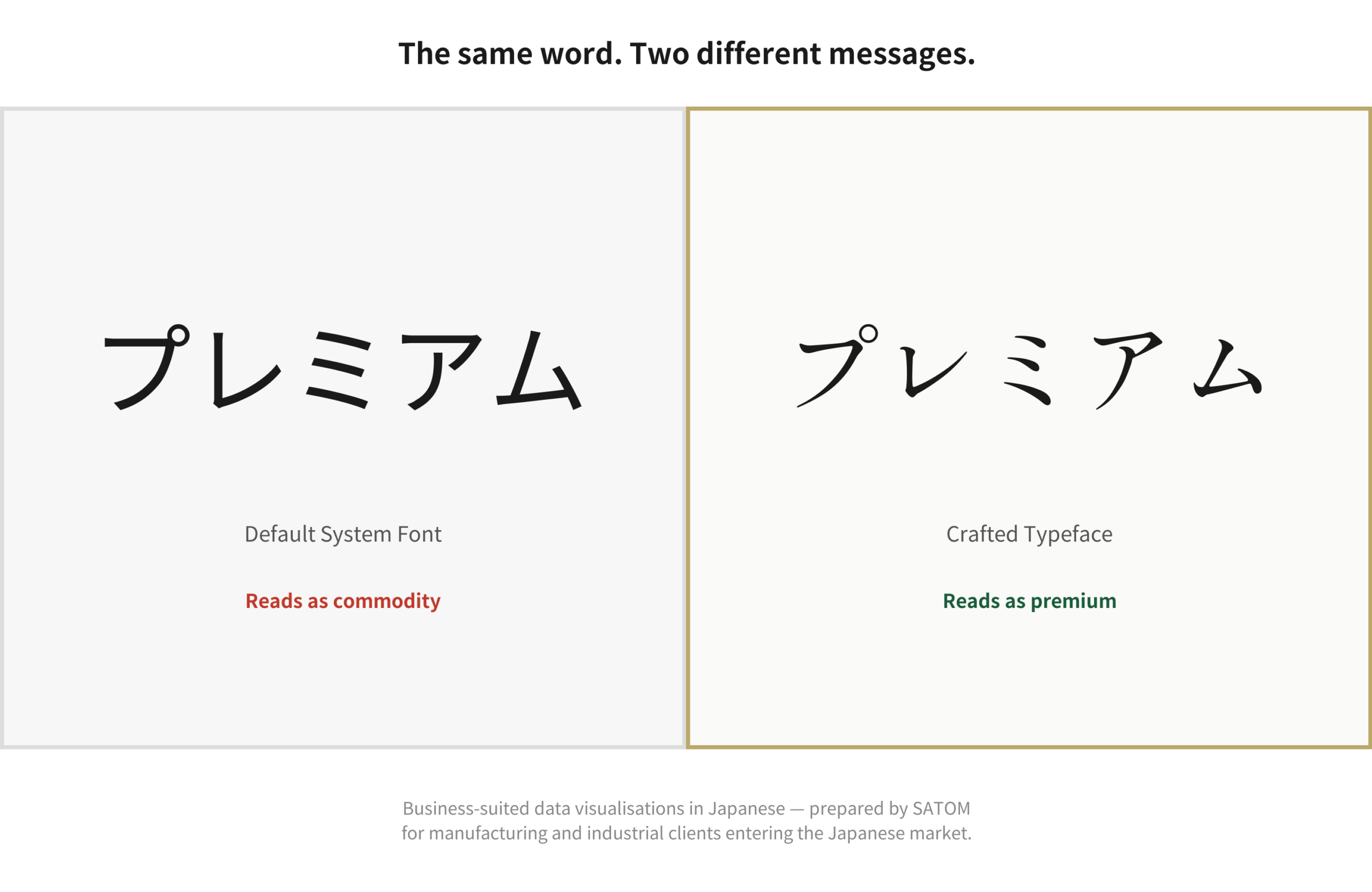
A common example: a European company producing premium products adds Katakana text to its materials using a default system typeface. In Europe, it looks clean and neutral. In Japan, that same neutrality reads as an absence of craft. Luxury in Japan is communicated through precision in every detail — including letterform. A default Katakana font on a premium product positions it alongside convenience goods, not aspirational ones.
Typography
Katakana and Kanji typefaces carry brand weight. Default system fonts signal low investment to Japanese readers.
Information Density
Japanese B2B readers expect structured, dense information. Sparse Western layouts can feel evasive or underprepared.
Data Visualisation
Labelled charts and structured infographics in Japanese outperform dense English whitepapers in every sales setting.
Layout Logic
Japanese readers scan in a structured top-to-bottom sequence. Clearly segmented blocks reduce cognitive friction.
Visual Checklist Before Your Japan Launch
- All images have Japanese-language captions or alt text
- Data visualisations use Japanese labels and business-standard formatting
- No placeholder machine translation remains in final assets
- Visual hierarchy matches Japanese B2B communication conventions
- Typography choices — especially in Japanese script — reflect the brand positioning
Mistake 3 — English-Only Exhibition Materials
One of the most visible failures in Japan market entry happens on the exhibition floor. Walk any major B2B trade show in Japan and the pattern is immediately clear: the majority of booths from non-Japanese companies display English-only content. Brochures, banners, product screens — all in English or roughly machine-translated Japanese. The assumption behind this is that Japan’s internationally connected business community is comfortable in English. Some are. Most are not, and even those who are will default toward suppliers who have made the effort to meet them in their language.
Who You Actually Attract With an English-Only Booth
English-only exhibition materials filter your booth traffic to English-fluent intermediaries — traders, import agents, and international-division staff. These are rarely the procurement-level decision-makers, technical evaluators, or senior buyers you came to meet. The gap between booth traffic and qualified Japanese prospects grows wider the more English-dependent your presentation is.
Printed Materials
Product sheets, brochures, and one-pagers in business-appropriate Japanese — ready to hand over at the booth, not promised for a later follow-up.
Digital Screens
Video scripts, slide content, and looping presentations adapted for Japanese reading rhythm and visual expectations.
Post-Booth Follow-Up
QR codes linking to Japanese-language landing pages. Japanese business cards. Templates for timely post-exhibition outreach.
Mistake 4 — Delegating Localisation to Your Japan Office
European companies at the structural stage of Japan market entry — those that already have a Japan presence — a subsidiary, a joint venture partner, or a contracted local distributor — often assume that local staff will handle localisation naturally. This assumption masks a recurring structural problem.
Local Japanese staff are skilled in their core roles. Localising European marketing content is rarely one of them. Under time pressure, they will reach for the same tools as everyone else: machine translation, default templates, and adaptations that prioritise speed over strategic alignment. The result is technically accurate Japanese that carries none of the brand positioning the European parent intended.
“Our Japan office is excellent at sales and client relationships. But when we asked them to adapt our European campaign materials, they returned documents that looked technically fine — and completely missed the tone we needed.”
— Business Development Director, European Technology Company
Japan Office Localisation
- Completed in spare time alongside core responsibilities
- Uses machine translation as a baseline
- Technically correct — strategically unaligned
- European brand intent is lost in the handover
Dedicated Bridge Specialist
- Localisation is the entire focus — not a side task
- Brand positioning is understood before work begins
- Output calibrated for the Japanese audience and context
- European intent and Japanese expectations are aligned
Mistake 5 — Underestimating the Decision-Making Structure
Japan market entry is not only a language challenge — it is an organisational one. Japanese companies operate through a consensus-building process called nemawashi (根回し), where decisions are discussed at multiple levels before being formally approved. Targeting only the C-level contact you met at an exhibition may stall your deal indefinitely — even if that person was genuinely interested.
C-Level / Directors
Executive Summary
Strategic value, ROI framing, partnership potential — concise and high-level. No technical depth needed at this layer.
Technical Evaluators
Technical Documentation
Specifications, compliance, integration details — in Japanese, structured precisely, with no ambiguity in terminology.
Procurement
Clear Value Proposition
Pricing structure, delivery terms, and supplier reliability — formal, clear, and verifiable without a follow-up call.
Understanding Nemawashi (根回し)
In Japanese business culture, a Japan market entry deal that appears stalled is often moving — just horizontally across stakeholders rather than vertically up the chain. Your materials need to survive hand-offs between departments, each of which will apply its own evaluation criteria. Materials designed for a single point of contact will not survive this process.
How SATOM Supports Your Japan Market Entry
SATOM brings 15+ years of B2B experience across European and Japanese markets to every engagement. The approach does not begin with the question “how do we say this in Japanese?” It begins with “what does success look like for the Japanese audience — and what needs to change to reach it?”
Japan-Suited Translation & Documents
Business-appropriate Japanese translations of brochures, one-pagers, and technical documents — written for Japanese B2B audiences, with register calibrated for your sector and your specific buyer profile.
Data Visualisation for Japanese Buyers
Structured infographics, product comparison charts, and performance visualisations with Japanese labels, logical segmentation, and visual hierarchies matched to how Japanese buyers process technical information.
Brand & Design Advisory
Review of visual assets — typography, colour, layout, packaging — through the lens of Japanese market expectations. European brand identity preserved while communicating correctly to Japanese sensibilities.
Whether you are at the earliest stage of Japan market entry — preparing for a first exhibition in Tokyo — or refining an existing Japanese-language website or building materials for a Japanese sales team, Japan market entry support from SATOM is built around your timeline and your commercial objectives — not a generic service package.
Ready to discuss your Japan market entry?
Tell us where you are in the process — exhibition preparation, website localisation, or full campaign support — and we will outline how SATOM can help.
Contact SATOM →Key Takeaways
Key Takeaways
- AI translation gets you 60% there. The final 40% — register, tone, and cultural framing — is where trust is won or lost in Japan.
- Visual language is a credibility signal. Default fonts, sparse layouts, and generic infographics communicate low investment to Japanese buyers.
- English-only booths attract the wrong audience. They filter out the procurement and technical decision-makers you most need to reach at exhibitions.
- Your Japan office cannot bridge this alone. Localisation strategy requires dedicated expertise at the intersection of both markets — not a side task for operational staff.
- Decisions move horizontally before they move vertically. Prepare tiered content for every stakeholder layer in the nemawashi process, not just the person you met.
Japan is a relationship-driven market where the quality of your preparation is visible before any conversation begins. Every stage of successful Japan market entry — backed by the right Japanese-language materials, the right visual assets, and a specialist who understands both sides of the relationship — is what separates a productive entry from an expensive learning exercise.
Related Articles
Japan Market Entry
Japan Market Entry
Further Reading and Sources
- JETRO — Japan External Trade Organization — official market entry guidance, sector data, and investment support for companies entering Japan
- Hofstede Insights — Japan Country Profile — cultural dimension analysis covering communication and decision-making patterns in Japanese business
- Harvard Business Review — Global Business — frameworks on cross-cultural communication, high-context markets, and international BD strategy
- EU-Japan Centre for Industrial Cooperation — practical entry support and sector intelligence for European companies operating in Japan