


Japan Market Entry · July 2026 · 8 minute read
Introduction
Japanese business materials written only in English may look polished on paper, but on a trade show floor in Tokyo they often fail to reach the audience you traveled there to meet. Panels at the booth, videos on the screen, brochures handed to visitors, all of it is frequently produced in English only, with the quiet assumption that English is understood everywhere business happens. That assumption is getting harder to defend, and the data backs this up.
This article looks at why relying on English business materials in Japan is a customer-oriented gap, not a minor detail. We will walk through recent proficiency data, connect it to established business school theory on cross-cultural communication, and explain what SATOM does to help companies prepare Japanese business materials that actually land with the audience in the room.
Table of Contents
- Introduction
- Why Japanese Business Materials Need More Than English
- The Data Behind Japan’s Falling English Proficiency
- What Business Theory Says About Cross Cultural Communication
- The Hidden Risk of AI Only Translation for Japanese Business Materials
- How SATOM Supports Your Japanese Business Materials
- Steps to Prepare Japanese Business Materials for Your Next Trade Show
- Key Takeaways
Why Japanese Business Materials Need More Than English
Walk any large trade show hall in Tokyo and you will see the same pattern. Many non-Japanese exhibitors put up English only panels, run English only product videos on the booth screen, and hand out English only spec sheets. It is efficient for the exhibitor. It is not always friendly for the visitor.
Why this matters to a visitor
- A Japanese engineer or buyer may read English fine but still prefer to process technical decisions in their own language.
- Booth staff often revert to simple English once questions get specific, and nuance gets lost fast.
- A visitor who has to work harder to understand your material quietly moves to the next booth that did not ask that of them.
Several non-Japanese business partners have told us the same thing over the years. English does not work as well as expected in Japan, even with a younger, more internationally exposed generation. We wanted to check that claim against real numbers rather than anecdotes, so we pulled the field data ourselves.
The Data Behind Japan’s Falling English Proficiency
We used the EF English Proficiency Index, an annual ranking built from millions of test takers across non-native English speaking countries. It is one of the largest public datasets available on this topic, and it let us track Japan’s position year by year instead of guessing from conversations alone.
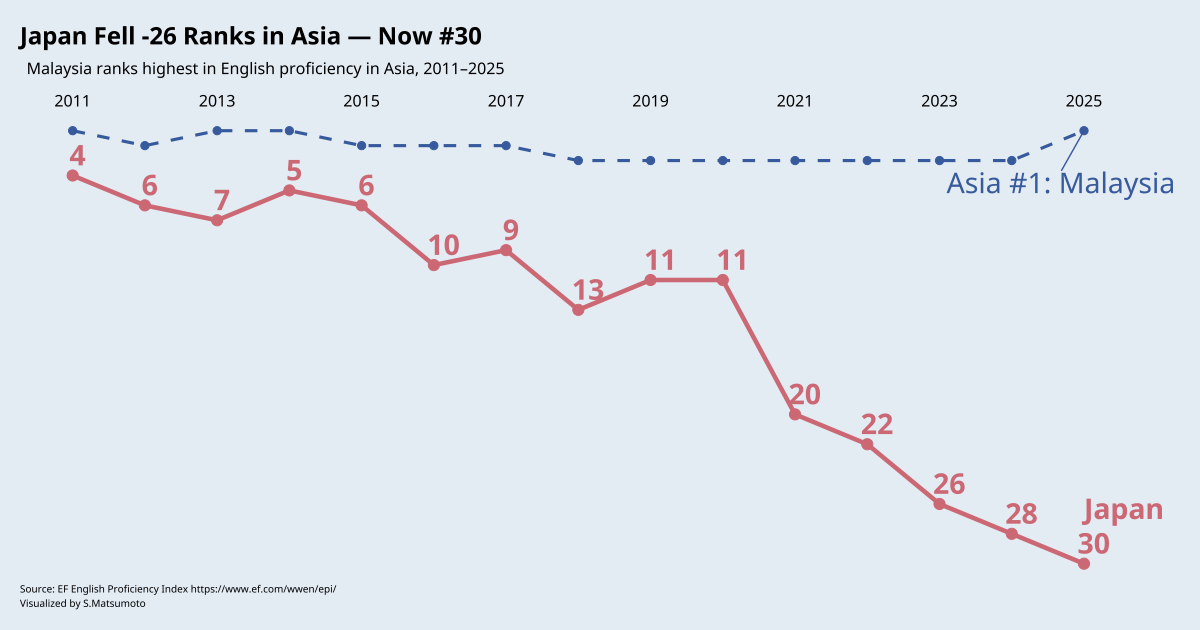
The trend line is not a small wobble. In 2011 Japan sat at number four in Asia. By 2025 it had slid to number 30, a drop of 26 places, while Malaysia held the top spot for the entire period. This is the regional picture that matters most for anyone comparing Japan to other Asian markets they may also be entering.
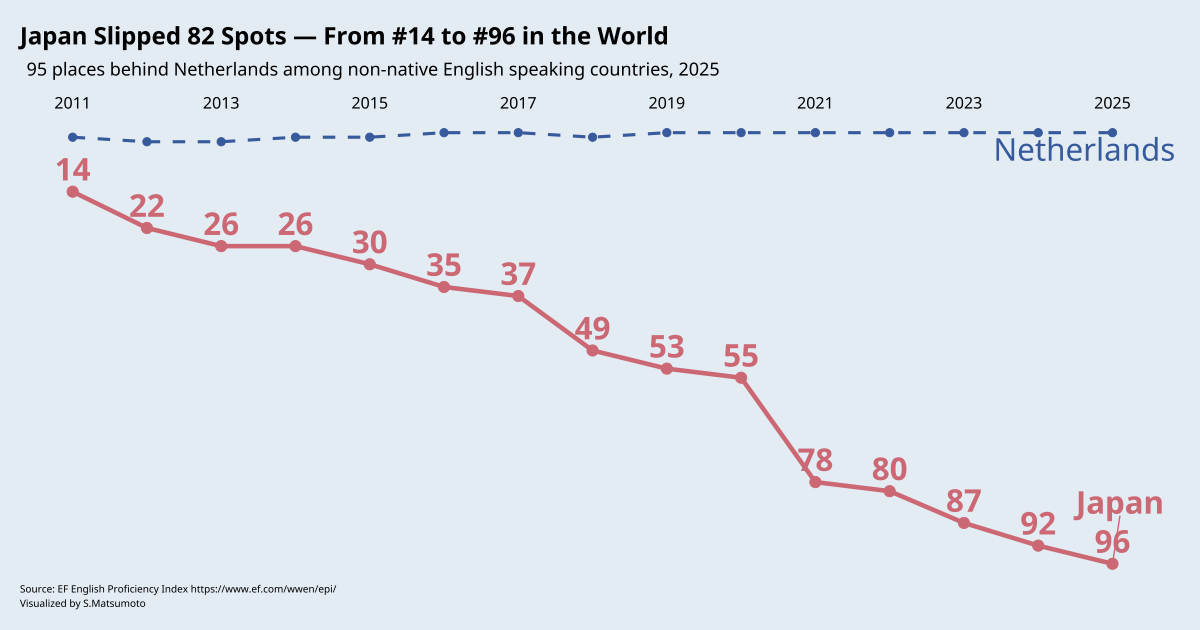
Zoom out to the world ranking and the fall looks even sharper. Japan moved from 14th place in 2011 to 96th place in 2025, an 82 spot decline among all non-native English speaking countries measured. That places Japan 95 spots behind the Netherlands, a country often used as the benchmark for strong non-native English use in business.
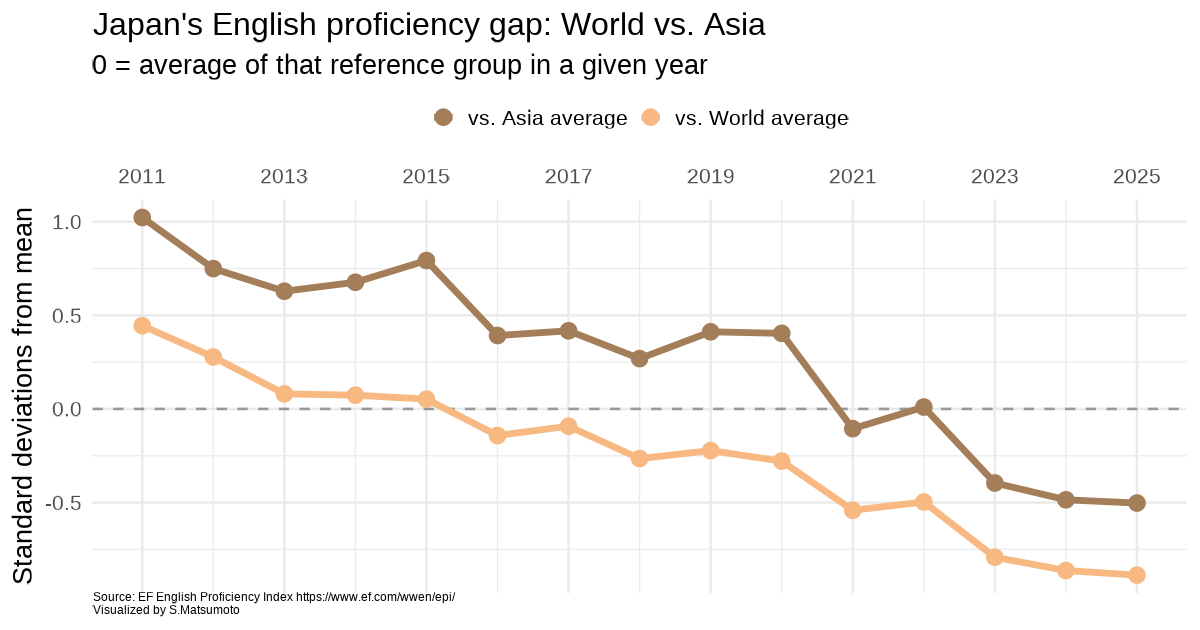
The third chart shows the gap in standard deviations from the average, so the world average and the Asia average both sit at zero regardless of year. In 2011, Japan sat clearly above both lines. By 2025 it sits below both. Japan has not just lost ground to leaders such as Malaysia or the Netherlands, it has fallen behind the average performance of its own peer groups.
This confirmed, with numbers rather than opinions, why so many business partners kept describing the same language wall on the ground. If your Japanese business materials still assume a rising tide of English ability, the tide is going the other way.
What Business Theory Says About Cross Cultural Communication
The proficiency numbers explain the mechanics, but business school research explains why the problem runs deeper than vocabulary.
High context communication
Anthropologist Edward T. Hall’s high context and low context framework, widely taught in business school courses on negotiation, places Japan firmly in the high context group. Meaning is carried as much by shared background and implicit signals as by the words on the page. A literal translation of an English slide can be linguistically correct and still miss the context a Japanese reader expects.
Cultural distance and the CAGE framework
In his Harvard Business Review article Distance Still Matters, Pankaj Ghemawat argues that companies routinely underestimate cultural and administrative distance because it is harder to measure than geographic distance. Language choice at a booth is a small, visible symptom of a bigger blind spot, the assumption that Japan is close to home simply because it is a major, developed economy.
Cultural intelligence as a business skill
Earley and Mosakowski’s Harvard Business Review piece on Cultural Intelligence treats the ability to adapt communication style to a new audience as a trainable skill, not a personality trait. Preparing localized Japanese business materials is one of the most concrete ways a team can put that skill into practice before a trade show, rather than learning the hard way in front of a visitor.
Hofstede’s country dimensions
Geert Hofstede’s national culture research, summarized for Japan by Hofstede Insights, scores Japan high on uncertainty avoidance. Visitors tend to value precise, well prepared, low ambiguity material. English text that reads as rough or approximate to a native speaker signals exactly the kind of ambiguity this audience tries to avoid.
The Hidden Risk of AI Only Translation for Japanese Business Materials
AI translation tools are a real help and a reasonable starting point. Speed and cost are hard to beat. But treating machine output as a finished deliverable creates a different kind of risk for your Japanese business materials.
- Hallucination: a model can invent a plausible sounding phrase that has no basis in the source sentence, and a reader outside the language cannot catch it.
- Dropped information: qualifiers, warnings, and conditions in the source text sometimes disappear quietly during automatic conversion, especially in longer technical passages.
- No way to verify it: if nobody on your team reads Japanese, you cannot check whether the output matches your original intent or your legal position on a spec sheet or contract summary.
This is the core question worth asking before you print a thousand panels or upload a translated technical brochure. How can you prove what the Japanese version actually says? That is where a second set of human eyes, familiar with both languages and the business context, becomes necessary rather than optional.
How SATOM Supports Your Japanese Business Materials
SATOM works with companies entering the Japanese market to close the exact gaps described above, before they show up on a booth or in a boardroom.
- Business material production in Japanese: slides, charts, and booth panels built for a Japanese trade show audience, not a direct copy of the English version.
- Contextually adjusted translation: a translation pass that checks meaning and business context, not only grammar, so nothing important gets softened or lost.
- Data reporting from Japanese sources into English: when your Japanese partner, distributor, or subsidiary sends reports in Japanese, SATOM turns them into clear English reporting your head office can act on.
The goal is straightforward. Your Japanese business materials should read as if they were written for the person standing in front of them, not translated at them.
Steps to Prepare Japanese Business Materials for Your Next Trade Show
1
List every touchpoint a visitor will see, panels, screens, handouts, business cards, and check which ones are English only today.
2
Rank those touchpoints by how much a decision depends on them, a spec sheet matters more than a giveaway flyer.
3
Run an App that SATOM customed for drafting Japanese text past a human reviewer who understands your business, not only the language.
Key Takeaways
- The English proficiency assumption is outdated: Japan has fallen 82 places worldwide and 26 places within Asia since 2011.
- Business theory backs the pattern: Hall’s high context research, Ghemawat’s cultural distance work, and Hofstede’s uncertainty avoidance findings all point the same direction.
- AI translation needs a human check: hallucination and dropped information are real risks in Japanese business materials that nobody on your team can read.
- Customer oriented materials win: the exhibitor who invested in proper Japanese business materials is the one visitors remember after the show.
- SATOM closes the gap: material production, contextual translation, and reporting support are available before your next trade show.
Getting your Japanese business materials right is one of the clearest ways to show that preparation.
Related articles
Japan Market Entry
Japan Market Entry
Further reading and sources
- EF English Proficiency Index, the annual dataset used for the charts in this article
- Harvard Business Review, Distance Still Matters, Pankaj Ghemawat on cultural and administrative distance
- Harvard Business Review, Cultural Intelligence, Earley and Mosakowski on adapting to unfamiliar business contexts
- Hofstede Insights, Japan country profile, national culture dimensions relevant to Japanese business materials
- More from SATOM on the SATOM blog