Who Shows Up at CPHI Japan 2026?
CPHI Japan 2026 exhibitors offer one of the clearest snapshots of global pharmaceutical trade available anywhere in Asia. With 666 unique exhibitor entries spanning more than 30 countries and five distinct show segments, this year’s edition is not just bigger than before — it is more structurally revealing. Understanding who is present, in which segment, and what they are talking about in the seminar rooms gives sales teams and procurement managers a genuine competitive edge before the show even opens.
At SATOM OÜ, we analysed the official CPHI Japan 2026 exhibitor list and seminar programme to map the landscape of the show. Here is what the data tells us.
What Is CPHI Japan?
CPHI Japan is Asia’s premier pharmaceutical ingredients trade show, held annually in Tokyo. It brings together global suppliers of pharmaceutical ingredients, outsourcing services, and bio-pharma solutions — all under one roof. It is five parallel markets operating under one roof at Tokyo Big Sight.
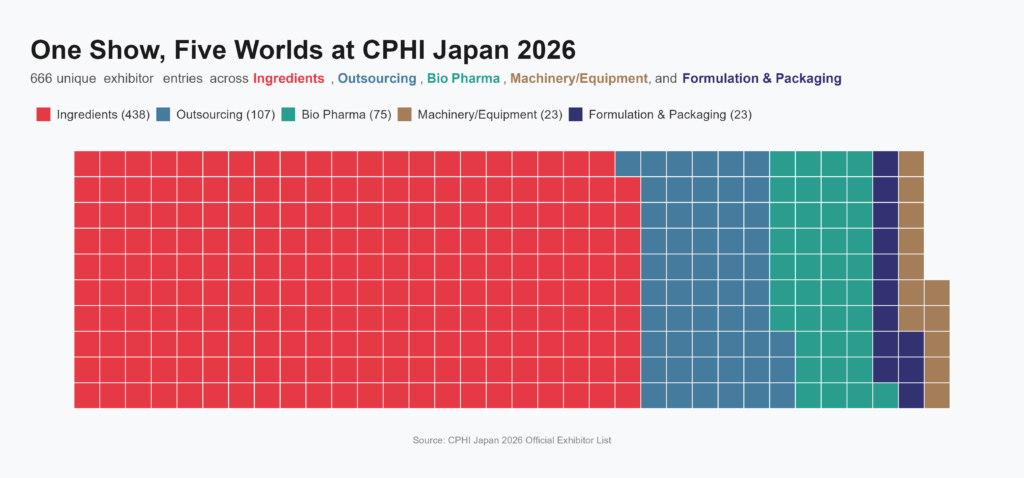
The five segments and their exhibitor counts are:
- Ingredients — 438 entries (66%)
- Outsourcing — 107 entries (16%)
- Bio Pharma — 75 entries (11%)
- Machinery/Equipment — 23 entries (3.5%)
- Formulation & Packaging — 23 entries (3.5%)
Ingredients is the dominant category by a wide margin. Nearly two out of every three exhibitor entries fall into this segment, reflecting Japan’s role as both a large consumer and an increasingly important validator of global pharmaceutical raw materials. If you are an ingredients supplier, you are entering the most competitive part of the show. If you are in Outsourcing or Bio Pharma, the field is thinner — and the conversations potentially more focused.
The addition of Machinery/Equipment and Formulation & Packaging compared to earlier data editions shows that CPHI Japan is broadening its industrial scope. These two segments each account for 23 entries — a relatively small but strategically meaningful slice, particularly for companies offering end-to-end manufacturing support rather than pure ingredient supply.
The Japanese-Language View: How the Show Looks From Tokyo
SATOM OÜ also produced a Japanese-language version of the segment analysis, designed for local pharma audiences and procurement decision-makers based in Japan.
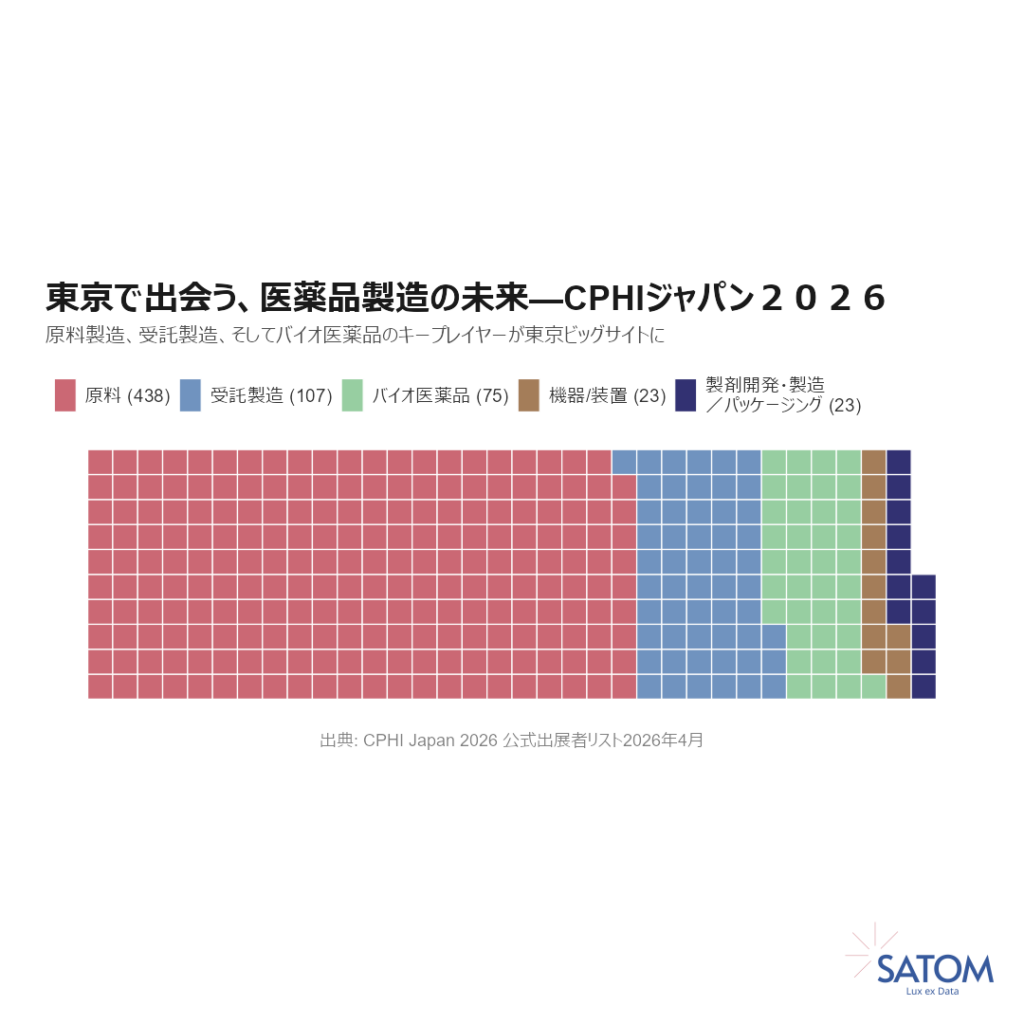
This matters for B2B context. Japan’s pharmaceutical procurement culture is relationship-driven and documentation-heavy. For foreign exhibitors targeting Japanese buyers, presenting data in Japanese — with locally appropriate framing — is not a courtesy, it is a sales tool. The same exhibitor landscape reads differently when contextualised for a Japanese audience evaluating potential suppliers from China, Europe, or North America.
This is the kind of localisation work that sits at the intersection of data communication and market entry strategy — which is precisely what SATOM OÜ builds for clients entering or navigating the Japanese industrial market. For more on this, see our guide to Japanese market entry for B2B companies.
What the Seminar Rooms Reveal: A Word Cloud of Pharma’s Priorities
Beyond the exhibit floor, CPHI Japan 2026 features an extensive seminar programme. We applied word frequency analysis to the seminar titles and descriptions to extract the dominant themes shaping the intellectual agenda of the show.
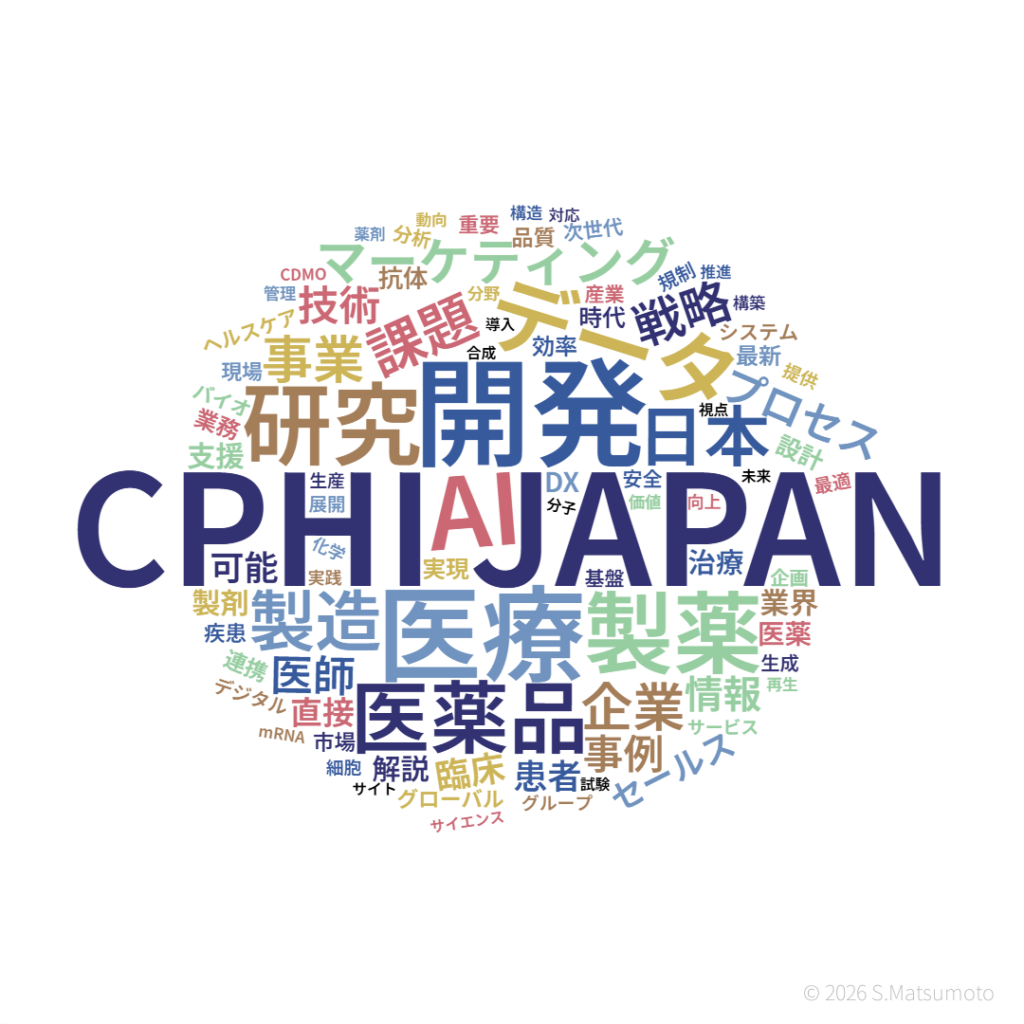
Several themes stand out immediately:
Development and research (開発, 研究) are the largest terms in the cloud — confirming that CPHI Japan is not purely a procurement event. It is where the industry comes to think out loud about what comes next.
AI and DX (digital transformation) appear prominently. The presence of AI as a standalone high-frequency term — in a conference dominated by Japanese-language content — signals that technology adoption in pharma manufacturing is no longer a niche conversation. It is a mainstream agenda item.
CDMO and mRNA both appear, reflecting the continued expansion of contract development and manufacturing organisations and the post-pandemic entrenchment of mRNA platform technology as a serious commercial pipeline.
Marketing and strategy (マーケティング, 戦略) feature more strongly than one might expect at a trade show often framed primarily around supply chain. This suggests that exhibitors and attendees are increasingly coming to CPHI Japan not just to source or sell, but to understand how to position themselves in a rapidly shifting competitive landscape.
Manufacturing and processes (製造, プロセス) anchor the more operational end of the agenda — consistent with the segment distribution we see on the show floor, where Ingredients and Outsourcing dominate.
Taken together, the seminar word cloud tells a story that the exhibitor list alone cannot: CPHI Japan 2026 is a show where supply chain meets strategy, and where operational procurement conversations share the room with forward-looking discussions about AI, biologics, and digital transformation.
What This Means for Sales and Procurement Teams
For sales teams, the five-segment structure creates sharper targeting opportunities. Knowing that Bio Pharma and Outsourcing combined represent fewer than 200 entries — against 438 in Ingredients — means that a well-prepared sales team in those segments faces less noise and more meaningful conversations. The seminar agenda also provides a content hook: aligning your booth messaging with the AI, CDMO, or DX themes dominating the seminar rooms positions your company as part of the conversation, not just the transaction.
For procurement managers, the show’s expanded scope into Machinery/Equipment and Formulation & Packaging means that CPHI Japan 2026 is increasingly a one-stop evaluation environment. With the right preparation, a single trip to Tokyo Big Sight can cover ingredients sourcing, CDMO assessment, and equipment benchmarking simultaneously.
For market entry planning, the Japanese-language audience that this show primarily serves requires communication that goes beyond translation. The framing, the data presentation, and the segment terminology all carry specific expectations in the Japanese B2B context. Our industrial sector reports and market entry work are built around exactly this challenge.
Key Takeaways
- CPHI Japan 2026 recorded 666 unique exhibitor entries across five segments
- Ingredients dominates with 438 entries — 66% of the total show
- Outsourcing (107) and Bio Pharma (75) offer less crowded, more targeted competitive environments
- Machinery/Equipment and Formulation & Packaging each contribute 23 entries, signalling a broader industrial scope
- Seminar word mining highlights AI, CDMO, mRNA, and DX as the dominant intellectual themes of 2026
- The show serves a primarily Japanese-language audience — local framing and data communication matter
Want a structured analysis of exhibitor or seminar data for your target market or industry event? See what SATOM OÜ delivers for B2B teams or contact us directly.