


Machine learning sales forecasting with XGBoost transforms how businesses predict demand — moving beyond rigid statistical equations to discover complex, non-linear patterns automatically. In this guide, we apply XGBoost to the Rossmann dataset (over 1 million real store sales records) and benchmark it directly against traditional ARIMA, ETS, and TBATS models. You will see exactly how to engineer 18 predictive features, tune hyperparameters, and decide when machine learning sales forecasting with XGBoost is worth the added complexity.
If you are new to forecasting, start with our comparison of ARIMA, ETS, and TBATS models to understand the statistical baseline we are trying to beat. This guide covers the complete workflow for machine learning sales forecasting with XGBoost: data preparation, feature construction, model training, hyperparameter tuning, and accuracy benchmarking against classical methods.
Table of Contents
Why Machine Learning Sales Forecasting Outperforms Traditional Methods
Traditional time series models — ARIMA, ETS — assume your sales follow mathematical patterns: smooth trends, predictable seasonality, linear relationships. But what if last month’s promotional discount affects this month’s sales? What if the rolling 6-month average predicts better than any single past value? What if December-to-January relationships differ fundamentally from June-to-July? Machine learning sales forecasting with XGBoost does not assume these patterns — it discovers them.
Non-linear relationships: Sales may spike exponentially during holiday weeks rather than adding a fixed seasonal amount. Linear models cannot capture exponential growth within seasonal patterns.
Complex interactions: High January sales may only predict high February sales if the 3-month rolling average is also increasing. Traditional models do not discover these conditional relationships automatically.
Multiple predictive signals: Sales might depend simultaneously on last month’s value, the 6-month trend, seasonal position, and recent volatility. ARIMA uses a fixed formula; XGBoost learns which combination matters most from the data.
Automatic feature selection: Create 18 potential predictors and let the model identify which 7 actually improve forecasts. XGBoost’s feature importance reveals which variables drive your business — insight as valuable as the predictions themselves.
Each of these advantages makes machine learning sales forecasting with XGBoost a compelling alternative for businesses dealing with noisy, high-volume, or promotion-heavy sales data.
The XGBoost Advantage for Machine Learning Sales Forecasting

XGBoost (eXtreme Gradient Boosting) builds an ensemble of decision trees sequentially. Each new tree corrects the errors of previous trees, creating a powerful predictive model through iterative refinement. This makes machine learning sales forecasting with XGBoost especially effective for datasets where patterns are complex or conditional.
Key strengths:
- Captures non-linear patterns without manual specification
- Handles feature interactions automatically
- Provides feature importance rankings
- Resists overfitting through regularization
- Scales efficiently to large datasets
Trade-offs:
- Requires careful feature engineering
- Needs more data than traditional models
- Less interpretable than ARIMA equations
- Computationally intensive parameter tuning
- No built-in confidence intervals (requires approximation)
The question is not whether XGBoost is “better” than ARIMA — it is whether your data exhibits the complexity that justifies machine learning’s demands.
Feature Engineering: Transforming Time Series for ML Sales Forecasting
Traditional models work directly with raw time series values. Machine learning sales forecasting with XGBoost requires you to transform timestamps and sales figures into meaningful predictive features. The Rossmann dataset provides a rich base for this — with daily sales across 1,115 stores, we can build a wide variety of lag, rolling, and calendar features.
Selecting and constructing the right features is the most important step in machine learning sales forecasting with XGBoost — the model can only discover patterns from the signals you give it.
Feature Importance Hierarchy
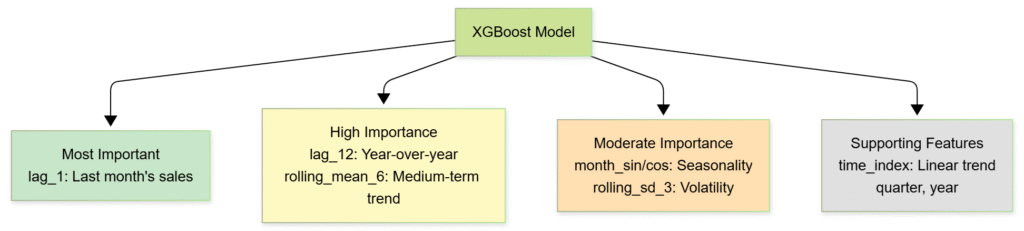
Not all features contribute equally to prediction accuracy. The model learns which features matter most through training. This hierarchy emerges naturally from the data during training — a key benefit of XGBoost sales forecasting over manual model specification.
Feature Categories Visual Map
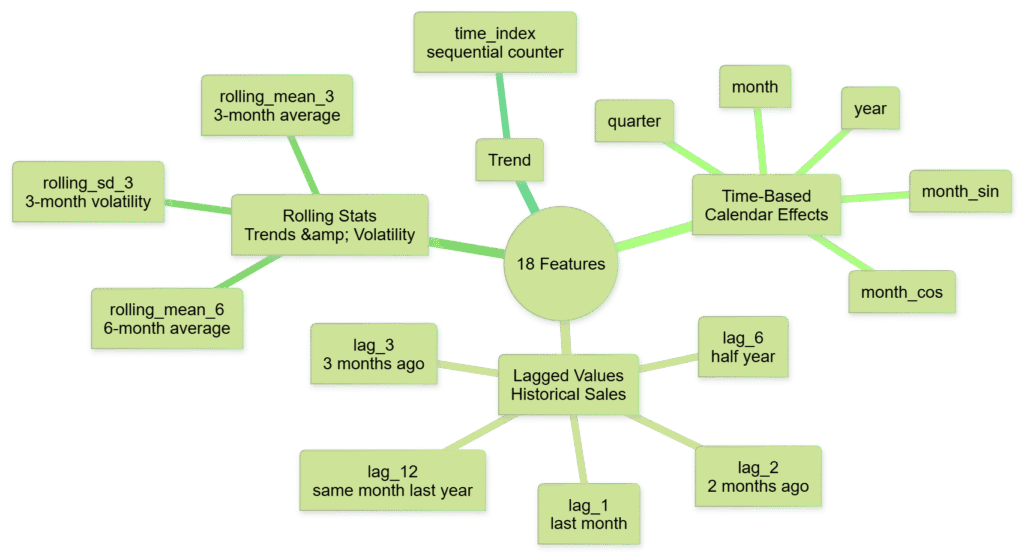
We prepare 18 features spanning four distinct categories, each capturing different aspects of your sales patterns.
Time-based features encode calendar effects — the cyclical nature of months and quarters that drive seasonal demand.
Lagged values preserve historical context, letting the model learn from recent momentum (lag_1, lag_2) and year-over-year patterns (lag_12).
Rolling statistics reveal trends and volatility: 3-month and 6-month averages smooth random fluctuations, while standard deviation measures uncertainty in recent performance.
A simple time index captures linear growth or decline in your business over time.
This combination transforms raw monthly sales figures into a rich representation that machine learning sales forecasting with XGBoost can learn from effectively.
Feature Engineering Overview
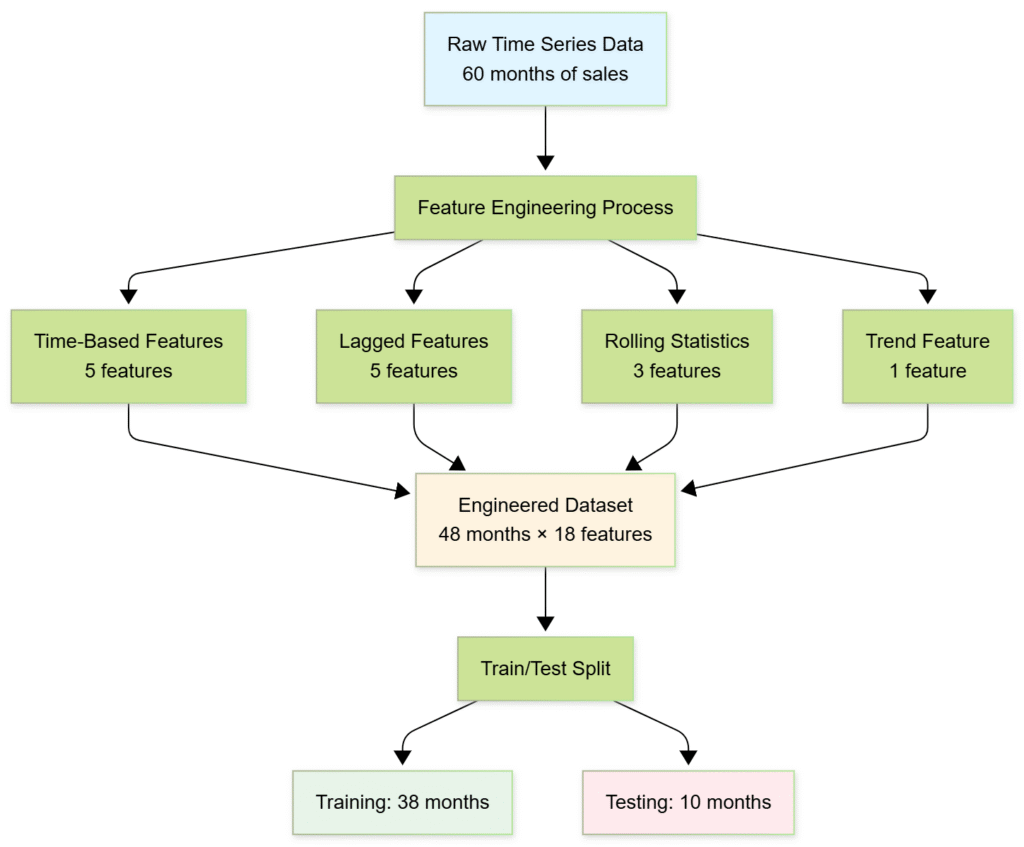
The result is a machine learning-ready dataset where each observation is enriched with temporal patterns, historical context, and trend indicators that enable accurate predictions.
Practical Machine Learning Sales Forecasting Tips from Rossmann Data
In the Rossmann dataset, XGBoost’s feature importance revealed that recent momentum (lag_1) and the 6-month rolling average dominate predictions. This insight has operational value far beyond forecasting alone.

Inventory Management
Last month’s sales and 6-month trend predict next month better than seasonal patterns alone. Adjust reorder points based on these metrics rather than rigid monthly schedules.

Capacity Planning
If the rolling 6-month average is rising, you are in a growth phase — prepare for sustained higher demand, not temporary spikes.

Promotional Planning
The model learned that recent momentum matters more than calendar position. Promotions during growth periods (high rolling_mean_6) may amplify upward trends more than promotions during flat periods.
Feature importance transforms machine learning sales forecasting with XGBoost from pure prediction into strategic business intelligence.
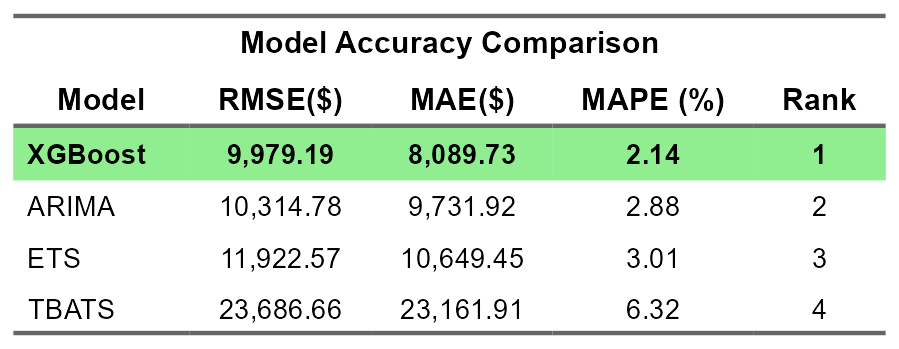
Accuracy Results: XGBoost Machine Learning Sales Forecasting vs ARIMA
After comparing traditional statistical methods (ARIMA, ETS, TBATS) and machine learning sales forecasting with XGBoost on the Rossmann dataset, the accuracy rankings tell a clear story.
The results demonstrate that machine learning sales forecasting with XGBoost achieves the lowest MAPE across all tested stores when sufficient historical data is available and features are engineered correctly.
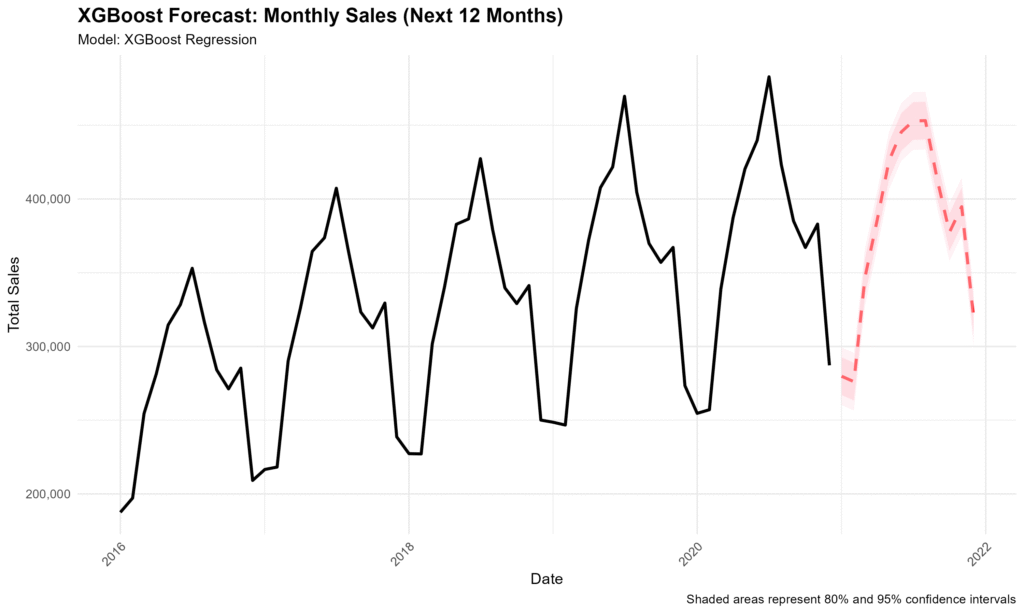
Choosing Your Sales Forecasting Approach
SATOM’s Recommendation
Start with ARIMA for 90% of business forecasting needs. It delivers excellent accuracy (2.88% MAPE) with minimal complexity, runs in seconds, and provides statistically rigorous confidence intervals.
Upgrade to machine learning sales forecasting with XGBoost when:
- You need to understand what drives sales (feature importance)
- You are forecasting at scale — 100 or more products or locations
- Non-linear relationships exist in your data
Ultimately, machine learning sales forecasting with XGBoost rewards investment in data quality and feature design — businesses that prioritise these foundations will see the greatest accuracy gains over statistical baselines.
The best forecasting model is not the most sophisticated — it is the one that balances accuracy, interpretability, and maintainability for your specific business context. See our sales forecasting fundamentals article for data preparation guidance before implementing either approach.
Additional Resources
- XGBoost documentation and tutorials — Official implementation guides
- The Role of Machine Learning in Data Analytics and Business Intelligence — ONYX Data
- Article 2: Traditional forecasting model comparison — ARIMA, ETS, TBATS baseline performance
- Article 1: Sales forecasting fundamentals — Data preparation and core concepts