


Introduction
A structured ROI approach is the single most powerful tool a pump sales professional can bring to a proposal meeting. Whether you are presenting to a plant manager or a boardroom of financial decision-makers, leading with a clear return on investment calculation transforms your offer from a cost into a strategic investment. In this article, we break down how to scale your ROI approach effectively across both mid-size and large industrial pump projects — so every proposal you submit wins more approvals and closes faster.
Why Every Project Size Deserves a Professional ROI Approach
One of the most common mistakes pump sales teams make is reserving detailed financial analysis only for large capital projects. In reality, every project — regardless of budget size — benefits from a professional ROI approach. When you can show a buyer exactly when their investment pays back and how much they save year after year, objections disappear and purchase decisions accelerate.
A scalable ROI approach also signals professionalism. It tells your customer that you understand their business, not just your product. According to research by McKinsey & Company, B2B buyers increasingly expect suppliers to quantify business impact before approving purchases. Delivering that quantification — at every project scale — is what separates top-performing sales teams from the competition.
Mid-Size Projects: Quick Wins That Prove Your Value
Applying a structured ROI approach to mid-size pump projects is where many sales professionals discover the fastest wins. Even a straightforward pump replacement can generate a compelling financial case when you model the numbers correctly. Consider a typical mid-size scenario where aging pumps are being replaced with modern, energy-efficient units:
- Energy Efficiency Gains: Modern pumps typically deliver 5–15% efficiency improvements, directly reducing electricity bills on a continuous basis.
- Maintenance Cost Reduction: New equipment significantly reduces service call frequency and the need for spare part replacements.
- Productivity Improvements: Reduced unplanned downtime translates directly into measurable operational savings and higher throughput.
When you apply a rigorous ROI approach to these factors, the numbers become undeniable. A €12,000 pump investment that generates €3,000 in annual savings produces a crystal-clear four-year payback period — a figure any operations manager can present to their finance team with confidence.
For a deeper look at how energy efficiency standards are driving pump upgrade decisions, the Europump industry publications provide excellent reference data you can incorporate directly into your proposals.
Large-Scale Projects: Comprehensive ROI Approach and Financial Modeling
For major industrial installations, your ROI approach needs to expand into full financial modeling territory. Large capital expenditure decisions involve multiple stakeholders — from engineering and operations all the way to the CFO — and each audience evaluates value differently. A comprehensive ROI approach addresses all of them in a single, boardroom-ready document.
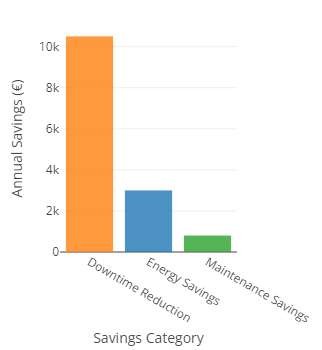
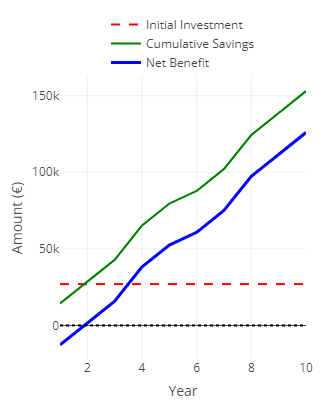
For large-scale proposals, a complete ROI approach incorporates the following financial dimensions:
- Productivity Enhancements: Fully quantified operational improvements tied to uptime, throughput, and process efficiency metrics.
- Labor Cost Savings: Calculated using current market wage rates and industry recruiting data to reflect real-world staffing impact.
- Energy Cost Analysis: Built using actual local utility tariff rates wherever available, making the savings figures directly verifiable by the client.
- Long-Term Financial Projections: 5–10 year investment recovery timelines, including net present value (NPV) and internal rate of return (IRR) calculations where appropriate.
This level of financial depth is precisely what procurement committees and financial controllers need to sign off on large capital budgets. By delivering it as part of your standard ROI approach, you remove the friction from the approval process and position yourself as a trusted business partner rather than just a vendor.
The International Energy Agency (IEA) estimates that industrial motor systems — including pumps — account for over 40% of global electricity consumption, giving substantial weight to the energy savings component of any pump ROI calculation.
The Competitive Advantage of a Scalable ROI Approach
While your competitors arrive with product brochures and specification sheets, a well-executed ROI approach positions you with a boardroom-ready financial case. This distinction is especially powerful when selling to larger organizations where capital expenditure decisions require sign-off from multiple departments with different priorities.
Procurement teams want the lowest price. Engineering teams want proven reliability. Finance teams want fast payback and positive NPV. A scalable ROI approach speaks all three languages simultaneously — and does so in a format that travels through the organization even when you are not in the room.
You can learn more about how SATOM builds these financial proposals on the SATOM services page and see how ROI reporting fits within a broader sales enablement strategy on our insights blog.
Key Takeaways
- A professional ROI approach applies to every project size — not just large capital investments.
- Mid-size pump projects can demonstrate clear payback periods (e.g., €3,000 annual savings on a €12,000 investment).
- Large-scale projects require comprehensive financial modeling including NPV, IRR, labor, energy, and productivity factors.
- A scalable ROI approach is a competitive differentiator that replaces price-based selling with value-based selling.
- Outbound data sources (IEA, McKinsey, Europump) strengthen your financial case with third-party credibility.
Transform every pump proposal into a strategic business case with a proven ROI approach. Contact SATOM to learn how customized ROI reports can differentiate your offerings and accelerate purchase decisions.