


Table of Contents
Introduction
Our Noise Rating Calculator is a free, browser-based tool designed to help engineers, architects, and acoustic consultants instantly evaluate indoor noise environments against internationally recognised NR curves. Whether you are designing a recording studio, specifying HVAC systems, or meeting building regulation requirements, this interactive noise rating calculator gives you professional-grade results in seconds — no software installation required.
What Is a Noise Rating Calculator?
A noise rating calculator is a tool that computes the Noise Rating (NR) number for a given indoor acoustic environment by comparing measured octave-band sound pressure levels against standardised NR curves. First defined by the International Organisation for Standardisation (ISO), NR curves are widely used across Europe and internationally to set permissible background noise limits for spaces such as offices, classrooms, hospitals, and concert halls.
The NR number is determined by finding the highest NR curve touched by any of the measured octave-band levels. For example, an NR-35 rating means the measured spectrum just touches — but does not exceed — the NR-35 curve at any frequency band. Common target values include NR-25 for bedrooms and recording studios, NR-35 for open-plan offices, and NR-45 for light industrial workshops. .
How to Use the Interactive Noise Rating Calculator
Using the noise rating calculator above takes less than a minute. Follow these four steps:
- Enter your octave-band SPL values — Input the measured sound pressure levels (in dB) for each of the standard octave-band centre frequencies: 63 Hz, 125 Hz, 250 Hz, 500 Hz, 1 kHz, 2 kHz, 4 kHz, and 8 kHz.
- Click “Calculate” — The tool instantly processes all eight frequency bands simultaneously.
- Read the NR number — Your calculated NR value appears in the results panel, clearly indicating which NR curve your measured spectrum meets or exceeds.
- Review the chart — The visual graph overlays your measured spectrum against the family of NR curves, making it immediately clear which frequency bands are driving the overall NR rating.
Understanding NR Curve Standards
NR curves were developed specifically to evaluate steady background noise in buildings, and they remain the dominant standard in European acoustic practice. They differ from the American NC (Noise Criteria) curves primarily in how the low-frequency and high-frequency ends of the spectrum are weighted. When using a noise rating calculator, it is important to understand which standard your local building regulations or client specifications require.
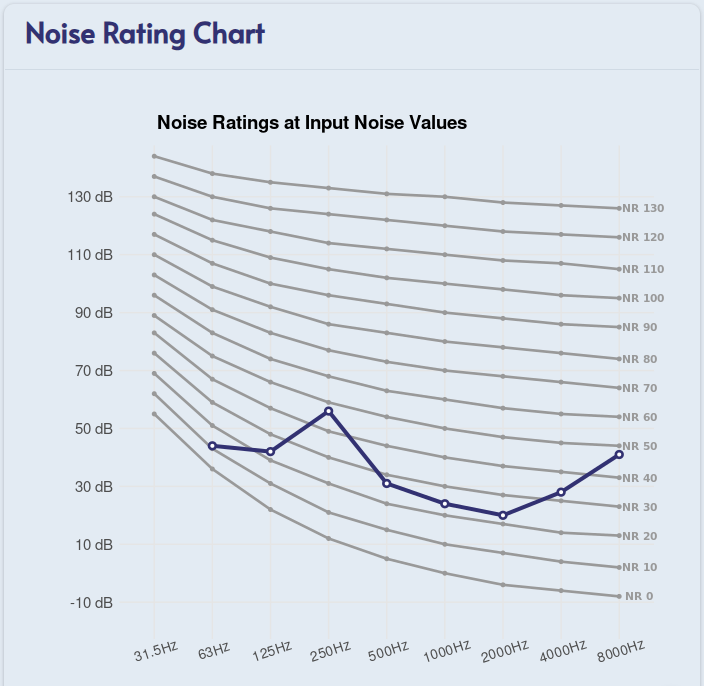
The table below summarises typical NR targets for common building types, as referenced in WHO Guidelines for Community Noise and BS 8233:2014:
| Space Type | Recommended NR Target |
|---|---|
| Recording studios / concert halls | NR-15 to NR-25 |
| Bedrooms / hospital wards | NR-25 to NR-30 |
| Private offices / conference rooms | NR-30 to NR-35 |
| Open-plan offices | NR-35 to NR-40 |
| Restaurants / retail spaces | NR-40 to NR-45 |
| Light industrial workshops | NR-45 to NR-55 |
5 Real-World Applications of Noise Rating Analysis
A noise rating calculator is not only useful in acoustic laboratories. Here are five professional scenarios where calculating NR values adds direct value:
- HVAC commissioning — Verify that mechanical ventilation systems meet the NR-35 or NR-40 targets specified in the design brief before handover.
- Building acoustics compliance — Demonstrate regulatory conformance for planning applications or building control sign-off.
- Office fit-out design — Compare pre- and post-treatment noise measurements to quantify the acoustic improvement achieved by added absorption or partitioning.
- Noise impact assessments — Support environmental noise reports with verified indoor background noise levels for residential and mixed-use developments.
- Classroom and educational buildings — Confirm compliance with BB93 Acoustic Design of Schools requirements, which specify NR-35 as the maximum for teaching spaces.
Let’s Collaborate
Are you impressed by how we have transformed complex acoustic calculations into an intuitive, branded web application? This noise rating calculator is just one example of how SATOM can enhance your digital presence with custom interactive tools that engage your audience while showcasing your expertise.
If you are interested in discussing how we can create similar custom applications for your business, we would love to hear from you.
Key Takeaways
- Our free noise rating calculator lets you compute NR values directly in your browser from octave-band SPL measurements.
- Results are displayed as both a data table and an NR curve chart for immediate, professional interpretation.
- Typical NR targets range from NR-15 (recording studios) to NR-55 (industrial spaces), depending on the intended use of the room.
- The tool is built on the open-source Shiny framework and requires no software installation.
- SATOM can build similarly branded, interactive web tools tailored to your organisation’s technical and visual requirements.