


How AI Japanese Translation Falls B2B Professionals
AI Japanese translation is improving fast — but for B2B professionals entering the Japanese market, fast is not the same as right. In this article, we walk through why machine-generated Japanese often misses the mark, and what a more grounded approach looks like.
Take a walk through any major Tokyo train station today and you will find Japanese advertising copy that reads just slightly off. The grammar is correct. The words exist. But something about the rhythm is wrong — like someone wearing the right clothes in the wrong season. That is what AI Japanese translation often looks like at scale: technically accurate, but contextually lost.
For businesses entering the Japanese B2B market, this distinction is not cosmetic. The language you use defines how your brand is perceived, whether a decision-maker reads on or clicks away, and whether a stakeholder trusts what they are reading. Getting that language from a machine — without meaningful human review — is like starting a demanding mountain trail wearing running shoes. You might cover ground, but you will struggle on the terrain that matters most.
Where AI Japanese translation loses the trail
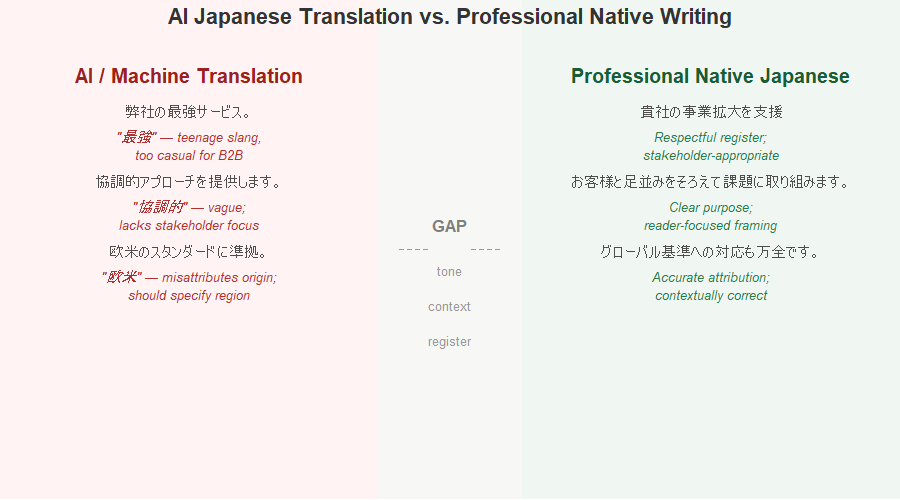
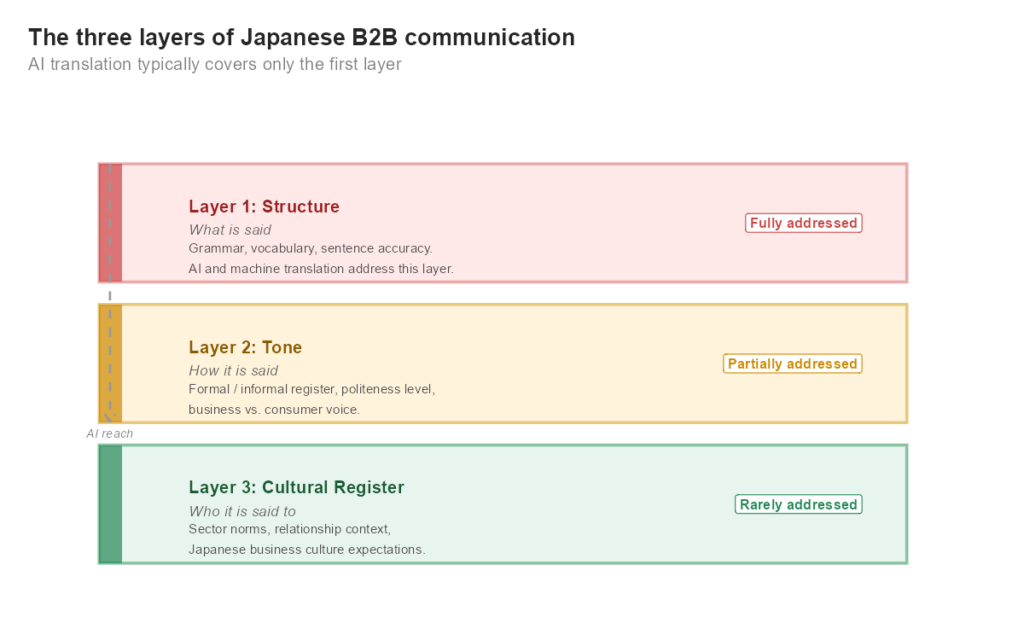
The first challenge is tone. Japanese is deeply contextual — the appropriate register for a business proposal, a product webpage, an executive briefing, and a trade conference brochure are all different. AI Japanese translation tools, however sophisticated, tend to apply a single register regardless of the situation. The result is either text that sounds too casual for a formal pitch, or so stiff and academic that it would feel more at home in a research journal than a landing page.
Machine translation has similar limitations. It performs well on literal accuracy — but accuracy to the source sentence is not the same as fitness for the Japanese reader. A sentence can be translated word for word and still communicate nothing useful. The reader understands the words but not the intent. This is a particularly sharp problem in B2B Japanese contexts, where the purpose of a document is often to persuade, reassure, or build credibility — not merely to inform.
The phantom vocabulary problem
There is a second, more specific problem with AI Japanese translation that many professionals do not anticipate: invented or misappropriated language.
AI models learn from existing texts. When those source texts contain errors — and Japanese texts written by non-native speakers or poorly localised content do contain errors — the model absorbs and replicates those errors at scale. One common example: products or services from Italy, or from non-Asian countries generally, are sometimes described in Japanese as “OUBEI” (欧米, meaning Europe and America) or simply “Kaigai” (海外, overseas). These are not wrong words. They are just the wrong words for the context. The nuance is lost entirely.
Another example is the word “SAIKYO” (最強), which loosely means “the strongest.” In recent years, this word migrated from teenage internet culture into mainstream Japanese advertising, used to mean anything from “most effective” to “best value.” It is catchy, certainly. But for a B2B software company, a professional services firm, or a financial product, it reads as immature — a business equivalent of describing your enterprise platform as “totally awesome.” The AI does not know the difference because it does not understand the cultural trajectory of the word. It simply registers that the word is used frequently in promotional contexts.
Trail marker
The gap between “technically correct Japanese” and “Japanese that actually lands” is where B2B deals are won or lost. AI Japanese translation often covers the first kilometre well — but stumbles on the climb where it matters most.
Why this matters more in B2B than B2C
Consumer advertising can sometimes get away with imprecise language. The audience is broad, the stakes of a single misread are lower, and a catchy phrase can compensate for a slightly awkward sentence. B2B Japanese translation operates in entirely different territory.
AI / machine translation
- Correct grammar, wrong register
- Flat/generic/wong tone
- Borrowed vocabulary from unverified sources
- No sense of audience or purpose
- Content generated, not crafted
Professional B2B Japanese
- Register matched to document type
- Credible, stakeholder-appropriate tone
- Vocabulary verified for context and sector
- Written toward a specific Japanese reader
- Story-led with professional precision
Your Japanese partners, clients, and stakeholders are reading your documents carefully. A whitepaper, a business proposal, or an investor presentation written in stilted or culturally misaligned Japanese signals, quietly but clearly, that you have not done the work. In a market where trust is built incrementally and first impressions are slow to recover from, that signal carries weight.
Reports versus stories: what accuracy alone cannot do
There is one more distinction worth naming. Accuracy in Japanese translation — even high accuracy — produces a report. A report tells you what something is. What a business document in the Japanese market often needs to do is something more: it needs to tell a story, establish a point of view, and carry a professional presence from the first sentence to the last.
Think of it like comparing a trail map to a guided walk. The map is accurate. It shows the path, the elevation, the distances. But it does not know where you tire, where the view opens up, or where you need reassurance that you are on the right track. A guide does. That difference — between transmitted information and communicated meaning — is what separates adequate Japanese translation from effective Japanese communication.
A different approach to Japanese B2B communication
The alternative is not to reject technology entirely. It is to treat the reader — not the source text — as the reference point. That means asking, at every stage: will a Japanese business professional read this and feel informed, respected, and persuaded? Or will they read it and feel that the author is looking at a screen and not at them?
Reports and internal documents may tolerate a certain degree of functional translation. But materials that reach stakeholders — proposals, presentations, website copy, executive communications — require accuracy, yes, but also narrative coherence and appropriate professional tone. These are not qualities that can be added at the end. They have to be built into the writing process from the start.
At SATOM, the approach to Japanese B2B content and translation is built around one principle: the reader comes before the text. Every document produced for the Japanese market — whether translated, adapted, or written from scratch — is evaluated for how it will land with its intended audience, not just whether it reflects the source material faithfully.
SATOM’s approach
Accuracy matters. But story-telling with a professional tone is what makes Japanese B2B content work. SATOM considers the reader at every stage of the writing and translation process — not just the words on the page.
Three questions to ask about your current Japanese content
Before investing further in AI-assisted Japanese translation for business use, it is worth asking:
1. Is the tone matched to the audience? A board-level briefing and a product brochure require different Japanese registers. Has someone with native-level business Japanese confirmed that yours is right?
2. Has the vocabulary been verified for your sector? Industry-specific terms, borrowed words, and trending expressions all carry associations. AI picks these up from general usage — not from your specific business context.
3. Does the document tell a story, or just report information? Japanese B2B audiences respond to clarity and coherence. If your document is technically accurate but narratively flat, it will not do the persuasive work you need it to do.
Further reading:
How Japanese business communication culture differs from Western styles — Nippon.com ↗
Japan market entry considerations for foreign companies — JETRO ↗
Ready to communicate with your Japanese audience?
SATOM works with B2B companies entering the Japanese market to produce content that resonates, persuades, and builds trust with Japanese readers.