


Table of Contents
A Technical Approach to Cultural Translation
When entering the Japanese market, many companies underestimate the importance of professional Japanese localization services. Imagine you’re hiking a mountain trail for the first time. You have a map, but it’s written in a language you barely understand. The trail markers exist, but they don’t quite make sense in your cultural context. You can technically follow the path, but you’re missing the stories, the significance of each landmark, and the emotional connection that makes the journey meaningful.
This is exactly what happens when international companies try to communicate their legacy to Japanese stakeholders using direct translation instead of proper Japanese localization services. If you are new to this topic, read our introduction to Japanese localization to understand the core concepts before diving into the project workflow below.
The Challenge: Beyond Words
When an Italian chemical company with 80 years of history needed to share their story with their Japanese parent company’s shareholders, they faced a critical decision. They could opt for standard translation services—fast, affordable, and technically accurate. Or they could invest in true Japanese localization services that would resonate emotionally with C-suite executives who hold the company’s future in their hands.
They chose the latter, and that’s where our work began.
The challenge wasn’t just translating words from English and Italian to Japanese. It was about transforming a corporate narrative into a story that Japanese business leaders—accustomed to reading annual reports from companies with century-long histories—would find compelling, credible, and emotionally engaging. This is the essence of what professional Japanese localization services deliver: cultural transformation, not just linguistic conversion. See also our related case study on Japanese market entry communication strategies for broader context.
Why Machine Translation Fails for Japanese Business Communication
Here’s a pain point many companies face when entering or operating in the Japanese market: they underestimate the gap between “understandable” and “resonant” communication. This is precisely why investing in dedicated Japanese localization services matters far more than simply running documents through automated tools.
Japanese corporate culture values precision, attention to detail, and narrative coherence. When shareholders receive materials filled with awkward phrasing, inconsistent terminology, or culturally tone-deaf expressions, it doesn’t just create confusion—it signals a lack of respect and professionalism.
Machine translation tools have improved dramatically, but they still produce what I call “translation without a soul.” They can convert words, but they can’t:
- Adapt poetic or emotional language to resonate with Japanese aesthetic sensibilities
- Maintain consistent tone across technical and narrative sections
- Navigate industry-specific terminology in pharmaceutical and chemical sectors
- Apply cultural judgment about formality levels appropriate for C-suite readers
For this 80th anniversary book project, machine translation would have been like using GPS coordinates to describe a beautiful landscape—technically accurate, but completely missing the point. Only human-led Japanese localization services can bridge that gap effectively.
Our Japanese Localization Services Approach: Precision Meets Culture
Coming from a background in business intelligence and seven years working within Japanese corporate environments, I approached this project the same way I approach data analysis: with systematic methodology, quality controls, and iterative refinement. Our Japanese localization services are built on four structured phases that ensure both linguistic accuracy and cultural resonance.

Phase 1: Foundation and Planning (Waterfall Methodology)
We structured the project using waterfall methodology because anniversary books have fixed deliverables, strict deadlines, and multiple stakeholders who need visibility into progress at each stage. This structured planning phase is a hallmark of professional Japanese localization services that consistently deliver on time and on quality.
Key activities:
- Established clear project scope with the client
- Created a comprehensive glossary of pharmaceutical and chemical terms
- Developed a RACI chart (Responsible, Accountable, Consulted, Informed) to clarify roles across multiple collaborating companies
- Built a Gantt chart to track milestones and dependencies
This might sound overly formal for translation work, but here’s the reality: when you’re coordinating between an Italian company, Japanese stakeholders, book designers who don’t read Japanese, and tight production deadlines, project management discipline isn’t optional—it’s essential.
Phase 2: Translation as Localization
The core principle guiding our Japanese localization services was simple: Japanese text should tell a story to Japanese readers, not simply convert foreign words into Japanese characters. Professional Japanese localization services require more than linguistic accuracy—they demand cultural intelligence.
Headline Treatment:
Every section headline received special attention. Rather than literal translation, we applied principles from Japanese poetry—specifically haiku techniques—to create headlines that:
- Evoked imagery and emotion
- Created anticipation for the content
- Maintained professional corporate tone while being memorable
For example, instead of a dry headline like “Establishment of Operations,” we crafted something that painted a picture in the reader’s mind while preserving the gravitas appropriate for a corporate history.
Technical Terminology:
The pharmaceutical and chemical sectors present unique challenges. Many technical terms have multiple possible translations in Japanese, and choosing the wrong one can confuse readers or sound amateurish.
We created decision trees for terminology selection:
- Is this term used in Japanese industry publications?
- How do major Japanese pharmaceutical companies use this term?
- Does the parent company have established internal terminology?
- Which translation maintains precision while remaining accessible?
Phase 3: Quality Assurance (The Missing Link in Most Translation Projects)
Here’s where our engineering industry background became invaluable. We didn’t just proofread—we implemented systematic quality procedures. Professional Japanese localization services implement systematic quality controls that amateur translators skip, and this phase is what truly separates expert work from generic output.
The One-Day Rule:
We discovered early that proofreading the same text multiple times in one sitting yields diminishing returns. Your brain starts seeing what it expects to see rather than what’s actually on the page.
Solution:
We spaced out five rounds of proofreading across multiple days, approaching the text with fresh eyes each time.
Quality Control Tools:
- Check sheets: Verified consistency of terminology, formatting, and style across all sections
- Track recording sheets: Documented every change, who made it, and why—critical when multiple revisions are happening
- Cross-reference matrix: Ensured that references within the book (page numbers, section citations) remained accurate through layout changes
Typography Management:
Japanese characters pose unique challenges for non-Japanese designers. Certain character combinations can look awkward, line breaks need to follow different rules than Romance languages, and font selection dramatically affects readability.
We created a typography guide specifically for this project, complete with visual examples, to bridge the communication gap with the design team. This level of detail is what distinguishes comprehensive Japanese localization services from basic translation offerings.
Phase 4: Stakeholder Collaboration
The project involved coordination between:
- The Italian client company
- Book design agency
We applied a hybrid approach here—waterfall for the main translation workflow, but agile principles for handling feedback loops and design iterations. This flexibility allowed us to maintain schedule discipline while accommodating the inevitable adjustments that occur when creative and corporate stakeholders review materials. Effective Japanese localization services bridge the gap between corporate messaging and cultural resonance by managing all stakeholders with equal care.
Theory in Practice: Quality Management Frameworks
To demonstrate our systematic approach, we drew from established quality management frameworks that underpin our Japanese localization services:
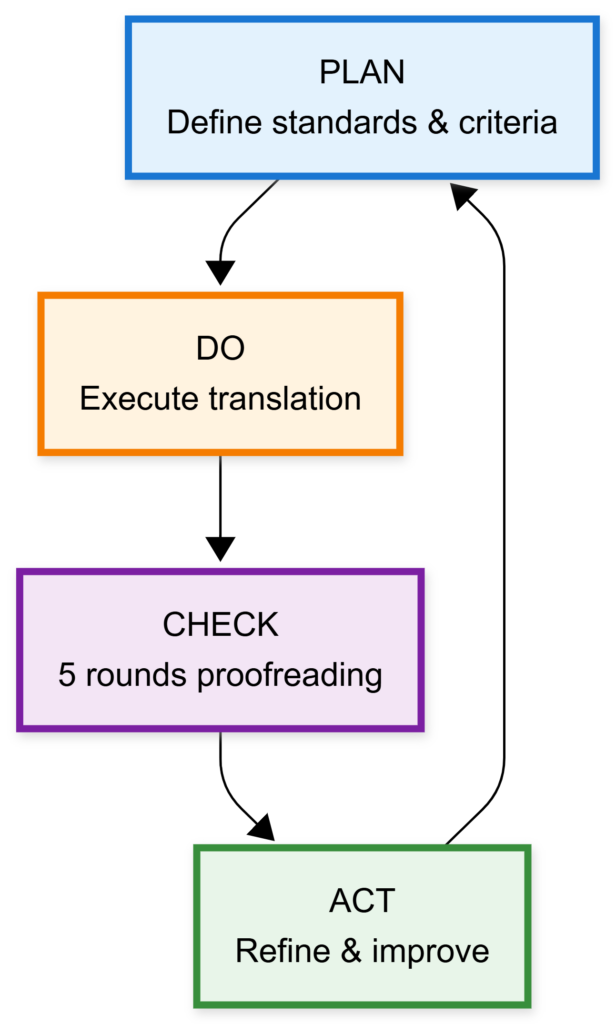
Plan-Do-Check-Act (PDCA) Cycle:
- Plan: Established translation standards and quality criteria
- Do: Executed translation following established guidelines
- Check: Implemented multi-round proofreading and quality verification
- Act: Refined processes based on findings from each review cycle
Six Sigma Principles:
We adopted a “defect prevention” mindset rather than “defect detection.” This meant:
- Creating terminology databases before translation began
- Establishing style guides upfront
- Building review checkpoints into the workflow
- Tracking error types to prevent recurrence
These aren’t just buzzwords—they’re practical frameworks that transform Japanese localization services from an art (unreliable, inconsistent) into an engineering discipline (systematic, repeatable, high-quality).
Results: When Japanese Localization Services Deliver Emotional Impact
The true measure of Japanese localization services success isn’t technical accuracy—it’s emotional resonance.
One thousand copies were printed and distributed. The feedback that mattered most came from a C-suite member of the Japanese parent company who read the book page by page. According to our client, this executive was genuinely moved and “really happy to read” the translation.
In Japanese business culture, such direct positive feedback from senior leadership is significant. It indicated that the text didn’t just communicate information—it created an emotional connection to the company’s 80-year journey.
This is the difference between translation and Japanese localization services. Translation says, “Here’s what the words mean.” Localization says, “Here’s what this story means to you, in your cultural context, speaking to your values and expectations.”
Key Lessons: Choosing Japanese Localization Services for Market Entry
If you’re planning to communicate with Japanese stakeholders—whether through reports, presentations, marketing materials, or corporate narratives—here are key takeaways from our experience delivering Japanese localization services at the highest level:
1. Budget for localization, not just translation.
The price difference might seem significant, but the cost of miscommunication with key stakeholders is far higher. Quality Japanese localization services are an investment, not an expense.
2. Involve native speakers with relevant industry experience.
Language fluency alone isn’t enough. Understanding business context, industry terminology, and corporate culture is essential to any effective Japanese localization services engagement.
3. Apply project management discipline.
Don’t treat translation as a “creative” process that happens organically. Structure it, track it, and manage it like any other critical business deliverable.
4. Build in time for multiple review cycles.
Quality cannot be rushed. Five rounds of proofreading might seem excessive, but it’s what separates professional-grade Japanese localization services from amateur output.
5. Create bridges between collaborators.
When your team includes people who don’t share a common language, invest in tools and documentation that facilitate clear communication across all parties involved in the Japanese localization services workflow.
Final Thoughts
Investing in Japanese localization services for your content isn’t about making things “sound Japanese.” It’s about respecting your audience enough to speak to them in a way that honors their cultural context, business expectations, and emotional intelligence.
Whether you’re translating an anniversary book, preparing investor materials, or creating marketing content for the Japanese market, the principle behind effective Japanese localization services remains the same: precision in process creates resonance in results.
Just like that first-time hiker who finally finds a guide who doesn’t just point to the trail but explains the significance of each landmark, your Japanese stakeholders deserve communication that doesn’t just inform—it connects. Ready to get started? Contact us to discuss your Japanese localization services needs today.